
AI-Aware Software Development: MCP, AI Agents and the Future of Engineering
November 25, 2025 / MatrixTribe
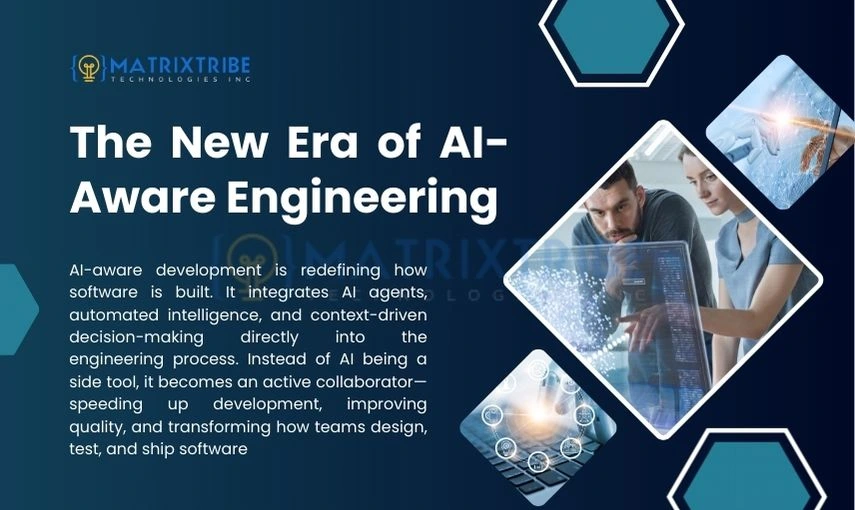
The software industry is entering a new inflection point. AI is no longer a productivity add-on or a niche helper; it is actively reshaping how software gets designed, built, tested, and maintained. The shift is already measurable: developers complete tasks up to 2× faster with AI assistance, and AI-augmented SDLC pipelines improve time-to-market by 16–30%.
But beyond the headline numbers, something deeper is happening. AI is becoming context-aware, integrated across the SDLC, and capable of collaborating with humans and tools in real time. It’s changing how teams structure work, how decisions get made, and how product velocity scales.
This blog breaks down what AI-aware software development actually looks like today and how teams can adopt it without adding operational complexity or disrupting existing engineering workflows.
2. What “AI Software Development” Actually Means
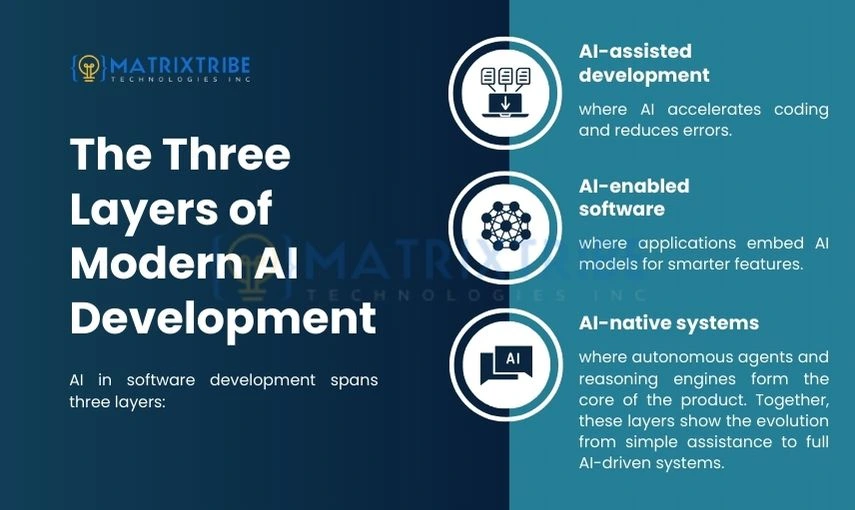
The term gets used everywhere, but it actually spans three very different layers. Understanding these layers helps teams know where they are today and what they’re trying to build.
AI-assisted development
This is the most common layer. Developers use AI tools to speed up coding, testing, refactoring, documentation, and debugging. The workflow stays the same; it just moves faster.
AI-enabled software
In this layer, the product itself uses AI models. The application still behaves like traditional software, but AI powers some of its capabilities. Examples include recommendation engines, NLP features, fraud scoring, forecasting, or image analysis.
AI-native applications and agent systems
This is the emerging frontier. These systems are built around AI from day one, not as a feature, but as the core engine. They rely on reasoning, autonomy, and multi-agent orchestration. The app adapts, learns, and interacts with users and tools dynamically.
How AI Is Transforming the Software Development Lifecycle (SDLC)
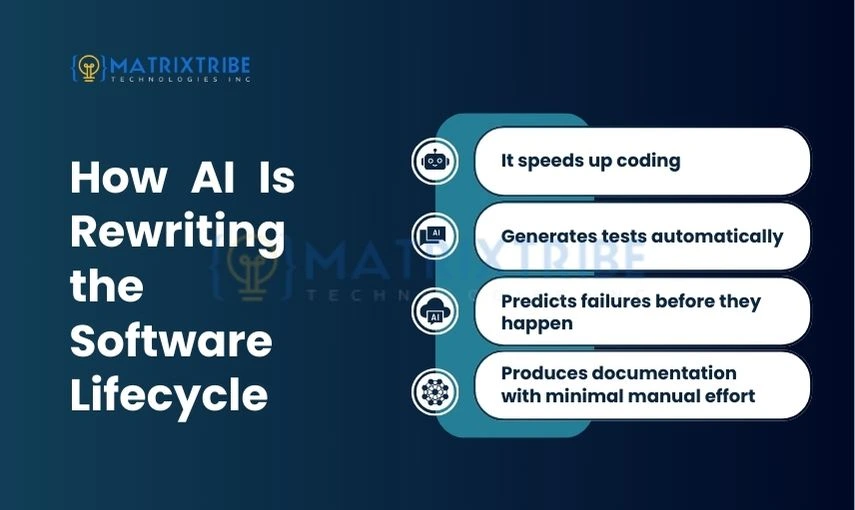
AI is reshaping every stage of the SDLC, not by replacing engineers, but by removing bottlenecks and making workflows more intelligent.
Faster Coding & Fewer Errors
AI accelerates development by generating code snippets, suggesting fixes, identifying vulnerabilities, and refactoring legacy code. Engineers spend less time on boilerplate and more time on architecture and logic.
Smarter, Automated Testing
Testing becomes continuous and more reliable. AI can auto-generate unit and integration tests, detect edge cases, identify regressions, and maintain test suites as code evolves. Bugs surface earlier, long before they reach production.
Predictive Maintenance and Reliability
AI models analyze logs, performance patterns, and telemetry to predict failures before they occur. Teams reduce downtime, optimize performance, and maintain more stable systems with proactive insights.
Automated Documentation & Workflow Simplification
From generating inline comments to producing full architecture documents, AI agents remove repetitive documentation overhead. It also streamlines tasks like environment setup, pipeline configuration, and code reviews, simplifying day-to-day engineering work.
AI-enhanced SDLC means engineering teams deliver higher-quality software faster, with fewer manual dependencies and fewer surprises.
The Business Value of AI Software Development
AI-driven workflows aren’t just an engineering upgrade; they create clear, measurable business impact. Organizations adopting AI-aware development consistently see improvements across product velocity, quality, and cost efficiency.
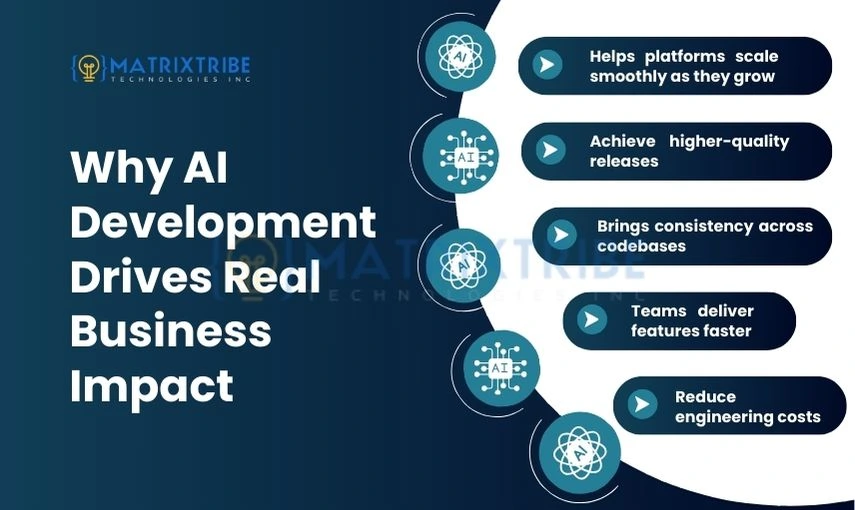
Faster delivery cycles
The addition of AI has led to a significant enhancement in delivery cycles. AI accelerates coding, testing, reviews, and deployment steps, allowing teams to ship features and updates 2 times faster.
Lower engineering costs
AI has increased developer productivity by 20-45% by automating repetitive work and improving efficiency. Hence, teams are now able to deliver more work with the same headcount. Moreover, the reallocation of resources to higher-value initiatives has also enhanced overall ROI.
Higher-quality releases
AI is not limited to writing code; it also aids in QA cycles. AI-supported testing, error detection, and predictive maintenance reduce bugs and production incidents, improving product stability.
More consistent codebases
AI enforces patterns, best practices, and style consistency across teams, leading to cleaner architectures and easier long-term maintenance.
Scalability for growing digital products
As products expand, AI helps teams handle increasing complexity from managing larger codebases to enabling multi-model capabilities and intelligent automation across environments.
Challenges and Risks
AI accelerates development, but it also introduces new considerations. It is imperative that you approach AI adoption thoughtfully to avoid avoidable risks. Keeping awareness of these risks ensures AI becomes a force multiplier, not a liability within the engineering organization.
Code Quality and Overreliance on AI
AI-generated code still requires human review. Without proper human oversight, AI can introduce subtle bugs, inefficiencies, or insecure patterns to the program.
Security and System Access
AI can now interact with code files, tools, and environments. In order to keep sensitive data secure, you have to enforce strict access controls. Even one poorly scoped permission can expose sensitive data to the AI systems.
Data Quality and Bias
AI outputs only perform as well as the data they rely on. Inaccurate or biased training data leads to unreliable recommendations and flawed automation. Hence, it is important to choose a verified database to use during processing.
Operational Complexity
There are multiple tools in the market that essentially perform the same job. However, integrating multiple tools without a clear organizational structure can fragment workflows. Thus, teams need clear governance and standards to prevent chaos.
MCP: The Most Important but Least Discussed Part of AI Software Development
As AI systems become more capable, the real challenge isn’t generating code or writing tests; it’s giving AI the ability to interact with real tools and real environments safely. This is where MCP (Model Context Protocol) becomes foundational.
What Is MCP (Model Context Protocol)?
MCP is a standardized protocol that defines how AI models can interact with development tools, data sources, and applications in a controlled and predictable way. Instead of ad-hoc plugins or custom integrations, MCP provides a formal structure for AI to discover available tools, understand what it’s allowed to do, request the information it needs, and execute actions with clear guardrails.
It’s not a model, not an agent, and not a framework. It’s the communication layer that makes every interaction between AI and your software environment consistent.
Why MCP Matters
MCP addresses the biggest operational challenges of using AI in real engineering workflows:
Controlled, permission-based tool access
AI only sees and uses the tools explicitly exposed to it and nothing more. This reduces the chance of unauthorized actions or unexpected behaviors.
Full auditability
Every AI interaction from reading a file to running a command, from reading a file to running a command, is structured and logged. This makes it easier to trace actions, debug issues, and enforce compliance standards.
Safer agent behavior
By limiting what an AI agent can access and by standardizing the commands it uses, MCP reduces the risk of harmful or unintended actions in production environments.
Easier integration
Engineers don’t need to build custom adapters for every tool. If a tool supports MCP, any AI agent that supports MCP can use it instantly.
Unified interface across systems
Whether the AI is interacting with a database, a file system, a cloud service, or a development tool, it speaks the same protocol. This consistency simplifies orchestration and reduces complexity.
In Simple Terms
MCP is the operating standard that allows AI agents to work safely with real systems.
It ensures AI behavior is predictable, permissioned, and production-ready, which is exactly what teams need when integrating AI into the heart of their software development lifecycle.
MCP turns AI from a helpful assistant into a trusted participant in real engineering workflows.
Conclusion
AI has moved far beyond simple coding assistance; it is transforming how software is designed, built, and maintained. From faster development cycles to smarter testing and predictive reliability, AI-aware software development is becoming the new baseline for modern engineering teams. But adoption only works when the foundation is solid. MCP provides that foundation, giving AI the structured, permissioned, and trustworthy access it needs to operate safely in real-world environments.
Teams that embrace AI with clear standards, intelligent tooling, and strong governance aren’t just improving productivity; they’re future-proofing their entire engineering workflow. The shift is here, and the organizations that adopt it early will build better software, scale faster, and innovate with fewer constraints.
Step Into The Future of Software Development
Want to understand what AI-aware development would look like in your environment?
At MatrixTribe Technologies, we build AI agents, Generative AI engines, and ML-driven intelligence pipelines that help teams accelerate delivery and reduce operational complexity.
Schedule a free consultation to explore what this could look like in your environment.
Published

Latest Article
 July 7, 2026
Explainable AI in Software Development: Why Every Output Needs a Trail
Read Article July 1, 2026