
Designing Enterprise-Grade Agentic AI Systems
January 6, 2026 / MatrixTribe

Many enterprises start their AI journey by choosing a model. Initial prototypes often show promise until they are asked to scale. That is when the real bottleneck appears: architecture. In agentic AI systems, the need for coordination, state handling, and orchestration is not a feature; it is the core design challenge. According to recent research, 78% of organizations now use AI in at least one business function, illustrating how pervasive intelligent systems have become across enterprises.
This article focuses not on security controls or ROI justification, but on how to architect scalable agentic systems that operate reliably in complex, evolving enterprise environments. Specifically, we examine how to design agentic AI architecture for enterprise environments, including multi-LLM systems, orchestration layers, and scalable execution patterns.
Why No Single LLM Is Sufficient
Enterprise teams increasingly search for ways to design scalable agentic AI systems, but most guidance focuses on models rather than system architecture.
One of the earliest design missteps in agentic systems is assuming that a single large language model (LLM) can serve all tasks. In practice, enterprise workloads vary significantly. Some require deep reasoning, others demand low latency. Some prioritize accuracy, others must optimize for cost.
Relying on a single provider introduces rigid cost structures, constrains capability choices, and creates vendor dependency. More importantly, it forces teams to design systems around model limitations rather than operational requirements.
From an architectural perspective, model selection must evolve into a runtime decision. Supporting this shift, 72% of organizations use generative AI in daily cloud operations, and 84% run AI in cloud environments. Systems should route tasks dynamically to the most appropriate model based on latency tolerance, context depth, and execution constraints. This reframes models from fixed dependencies into interchangeable resources.
Multi-LLM Strategy as an Architectural Pattern
To support diverse enterprise requirements, agentic architectures increasingly require multi-LLM strategies. This is not about redundancy or experimentation; it is a deliberate system design choice. In fact, research shows that while 80% of organizations use multiple AI models, only 28% have effectively integrated their applications, indicating a significant architectural gap in current deployments.
A multi-LLM pattern enables:
Cost optimization by routing lower-risk tasks to lower-cost models
Capability matching, where specialized models handle specific functions
Operational flexibility when providers, policies, or constraints change
Technically, this requires an abstraction layer between applications and models. Without it, integrating or replacing models becomes brittle and difficult to scale. Architects must decouple capabilities from providers, ensuring system behavior remains stable even as models evolve.

Provider Abstraction and Orchestration
Direct integration with individual LLMs produces tightly coupled systems. Any change to provider updates, endpoint shifts, or policy adjustments ripples through applications and services.
An orchestration layer resolves this by introducing controlled indirection. Most organizations are already running AI workloads in the cloud, with 84% using AI inside cloud environments, according to recent industry data. It is responsible for:
Routing requests to the most appropriate model
Managing context across tasks and sessions
Coordinating agent behavior in multi-step workflows
This abstraction enables:
Model substitution with minimal downstream impact
Policy enforcement at the system level
Centralized control over agent interactions
A core design principle emerges: applications should depend on capabilities, not vendors. This inversion supports resilience, adaptability, and long-term maintainability.
The Three-Tier Architecture for Agentic Systems
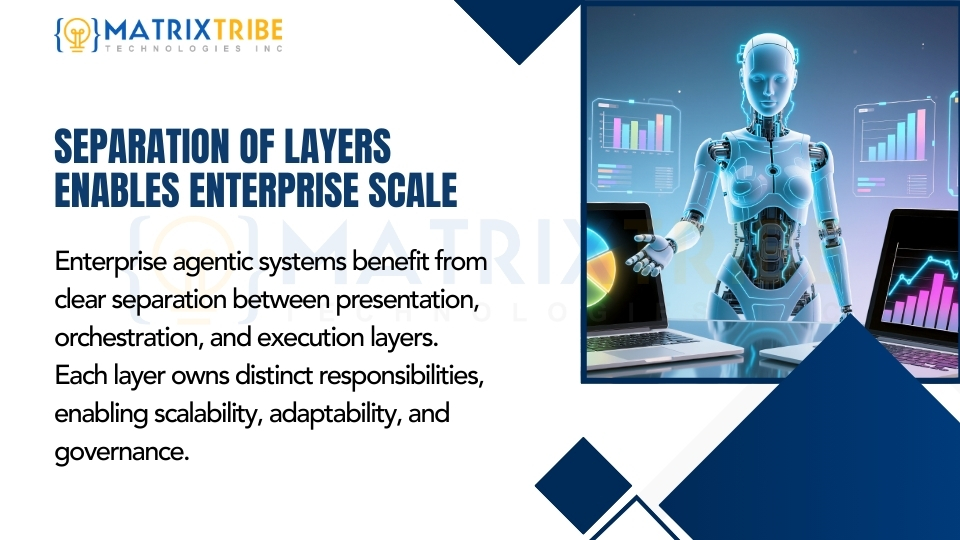
Enterprise-grade agentic systems benefit from a clear separation of architectural responsibilities. A three-tier model allows systems to scale, adapt, and remain controllable as complexity increases.
The three layers are:
Presentation Layer — where interactions occur
Orchestration Layer — where intelligence resides
Execution Layer — where actions are carried out
Each layer serves a distinct role.
Presentation Layer
The Presentation Layer interfaces with users and other systems. It may include:
Front-end applications
Dashboards and tools
APIs exposed internally or to partners
Its responsibilities include:
Accepting inputs (text, voice, structured data)
Displaying outputs and responses
Initiating task context
This layer should remain thin and stateless, focusing on interaction rather than logic. Keeping it lightweight allows interfaces to evolve without disrupting core system behavior.
Orchestration Layer
The Orchestration Layer is the core of agentic behavior. It manages:
Task decomposition into executable steps
Model routing based on capability and context
Coordination between multiple agents
This is where system logic lives. It determines how processes flow, how agents collaborate, and how decisions progress across steps.
The orchestration layer enables:
Consistent application of system policies
Reusable agent behaviors across use cases
Scalable coordination across teams and workflows
Without orchestration, agentic AI becomes a collection of disconnected endpoints rather than a coherent system.
Execution Layer
The Execution Layer performs real-world actions initiated by agents, including:
Making API calls
Reading from or writing to data sources
Triggering internal workflows and systems
Its responsibilities include:
Executing instructions from the orchestration layer
Managing integrations with existing enterprise systems
Reporting execution outcomes
Execution must remain controlled and observable. Defined constraints and escalation policies ensure that actions occur within acceptable operational boundaries, particularly in critical workflows.
Framework Ecosystem and Selection Considerations
A wide range of open-source and commercial frameworks exists to support agentic system development. These frameworks can accelerate implementation and standardize interaction patterns.
However, no framework is universally optimal. Selection depends on:
Integration requirements within the existing stack
Team skills and operational familiarity
Deployment environments (cloud, hybrid, on-prem)
Frameworks are implementation tools, not architectural foundations. Architecture defines system behavior; frameworks should support, not dictate that design.
Designing for Change, Not Optimization
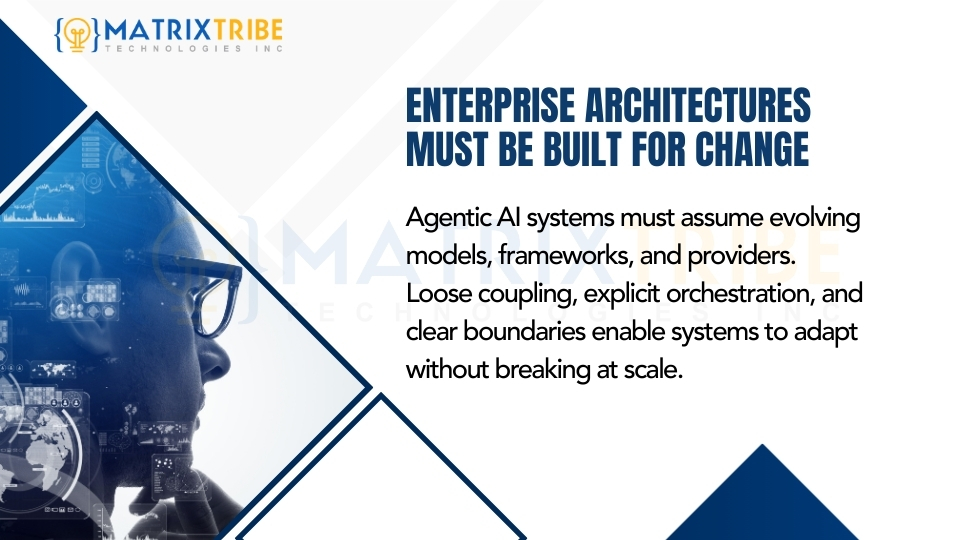
Agentic systems evolve rapidly. Models improve. Providers shift. Capabilities expand. Architectures optimized for a single configuration quickly become constraints.
Sustainable systems are governed and designed for change. This requires:
Loose coupling between components
Clear boundaries across architectural layers
Explicit orchestration logic that can adapt over time
Flexibility is not optional. Enterprises must assume that today’s models, frameworks, or providers will eventually be replaced. However, 62% of organizations report that their data systems aren’t correctly configured to leverage AI, indicating that the lack of integration infrastructure continues to limit scaling. Architectures that accommodate this reality are the ones that endure.
Conclusion
Agentic AI systems succeed or fail based on architectural choices. Scale is not limited by access to models, but by how effectively systems coordinate decisions, manage context, and adapt to change.
In production environments, these architectural patterns are already being applied to use cases such as AI-driven customer support systems, internal copilots, and automated decision workflows. The difference between successful deployments and failed prototypes consistently comes down to how well orchestration and execution layers are defined.
In the following article, we examine how platform teams deploy these systems in real environments, addressing security, cost behavior, and operational constraints that emerge once agentic AI moves into production.
Ready to Operationalize Agentic AI Architecture?
Enterprise-grade agentic AI depends on architectural discipline long before systems reach production. As organizations move beyond prototypes, clear separation of concerns, orchestration layers, and adaptable multi-LLM strategies become essential for scale.
MatrixTribe works with platform and architecture teams to design enterprise-ready agentic AI systems built for change, integration, and long-term operation. Our approach follows SOC 2-aligned practices, ensuring architectural decisions support controlled execution, accountability, and operational clarity.
Start the conversation: https://www.matrixtribe.com/contact-us/
Published

Latest Article

 July 7, 2026
Explainable AI in Software Development: Why Every Output Needs a Trail
Read Article July 1, 2026