
How to Scope a BDC LIFT Technology Project Before You Apply
July 20, 2026
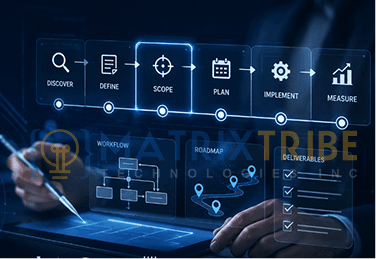
If you want to avoid slipping into the dark age while competitors move forward with AI, the time to plan is now. Only 30% of Canadian SMEs used AI in 2025, which means most businesses are still standing at the edge of adoption instead of moving into it. The real risk is watching competitors modernize while your business stays tied to old systems, manual work, and disconnected data.
BDC LIFT is filling that gap by giving eligible Canadian businesses a way to plan and finance advanced technology investments. But financing does not replace project clarity. Before you apply, you need to know what you want to improve and how the investment will create business value.
This article explains how to scope a BDC LIFT technology project before you apply, so your idea can move from a broad goal to a project you can plan, fund, and deliver.
Why Project Scope Matters for BDC LIFT
Project scope is not just paperwork. It is the bridge between the business problem you want to solve and the technology investment you want BDC to review.
BDC LIFT combines consulting and financing, but both tracks still require a plan. For Digital Transformation and AI, BDC requires a BDC Advisory Services Plan. For Productivity and Advanced Equipment, a productivity plan is required, and BDC Advisory Services can help you build or refine it.
A clear scope helps you explain the investment, estimate the work, avoid the wrong tools, and move into delivery with fewer gaps. The clearer your scope is, the easier it becomes to plan the project, discuss the investment, and build technology that solves a real business problem.
What Your BDC LIFT Project Scope Should Include
A strong project scope should make the investment easy to understand. It should show what problem you want to solve, what part of the business will change, and what result you expect after the technology is in place.
The Business Problem Behind the Upgrade
Start with what is slowing you down. Maybe your team spends too much time on manual reporting. Maybe you lack visibility across operations, lose time to repeated data entry, or struggle with slow customer response.
If you're an equipment-heavy businesses, the problem may be downtime, weak monitoring, or delayed operational data. For digital projects, it may be poor data quality, outdated workflows, or weak cybersecurity controls.
The point is simple: do not start with the tool. Start with the business pain.
The Workflow You Want to Improve
Next, name the workflow your project will change. That could be customer intake, quoting, dispatch, inventory visibility, reporting, equipment monitoring, compliance documentation, or forecasting.
Once you define the workflow, it becomes easier to see where workflow automation, AI agents, or application development may fit naturally.
The Systems Your Project Depends On
Most technology projects depend on systems you already use. Your scope should identify the CRM, ERP, spreadsheets, cloud systems, databases, equipment platforms, internal tools, and access permissions involved. It should also flag whether the data is clean, complete, and usable.
This is where many projects become clearer. Sometimes the first need is not AI. It is stronger data infrastructure, better system integrations, or cleaner access control before AI or automation can work properly.
The Result You Want to Measure
A stronger scope defines what improvement should look like. For example, you may want to reduce weekly reporting time, automate intake routing, connect CRM and operations data, improve equipment visibility, reduce duplicate entry, strengthen access control, or shorten response time.
Clear outcomes help you judge whether the project worked. They also keep the investment tied to business value instead of technology for its own sake.
The Vendor Role in Delivery
Your scope should also clarify what the technology vendor will deliver. That may include technical discovery, system design, software development, data pipeline setup, AI workflow implementation, integrations, testing, deployment, and support.
This keeps expectations clear from the start. You know what your internal team owns, what the vendor owns, and what needs to happen before the project can move from planning into delivery.
How to Turn a Broad Technology Idea Into a Buildable Scope
A broad idea becomes useful when you narrow it into one process, one set of requirements, and one realistic delivery path. The goal is not to modernize everything at once. The goal is to start with a project that can be built, tested, and measured.
Start With One High-Value Process
Start with the process where better technology would create the clearest business impact. That could be reporting, quoting, equipment monitoring, or another workflow that slows your team down every week.
Trying to modernize too much at once can stretch the budget, confuse priorities, and delay results. A focused first project gives you a stronger scope and a better chance of proving value early.
Decide What Needs to Be Built, Connected, Automated, or Secured
Once the process is clear, define the actual technology work. You may need to build a dashboard, connect ERP and CRM data, automate reporting, add an AI agent, secure a workflow, or create a data pipeline.
This step turns the idea into something your team, vendor, and funding reviewer can understand. It also helps separate what is essential now from what can wait for a later phase.
Phase the Work Realistically
A strong scope also needs a practical delivery sequence. A simple roadmap can look like this:
Discovery and scope: Define the business problem, workflow, users, systems, and expected outcome.
Roadmap and architecture: Decide how the system should be built, connected, secured, and phased.
Build and integration: Develop the software, dashboard, automation, AI workflow, data pipeline, or system integration.
Testing and launch: Test the system for usability, security, data accuracy, and business fit.
Support and improvement: Improve the system after launch based on real use, feedback, and business needs.
This keeps the project grounded. You are not only asking for technology funding. You are showing how the work can move from idea to delivery.
What to Have Ready Before You Apply
BDC’s LIFT process starts with an online request, followed by a conversation with an advisor and financing review if the project moves forward.
Before that conversation, your scope should be clear enough to explain in plain business terms:
what problem you want to solve
what technology investment you are considering
what outcome you expect
what role your technology vendor will play
This is not about preparing a perfect technical document. It is about making sure your project is specific enough to discuss, review, and move toward delivery. MatrixTribe can help shape the technology scope and delivery plan, while BDC reviews and approves the application.
Where MatrixTribe Fits in the Scoping and Delivery Process
As a qualified tech vendor MatrixTribe helps you turn a broad technology investment idea into a scope that can be planned, built, and used.
we map the workflow
we define the technical scope
we identify systems, data, and integration needs
we shape the implementation roadmap
we build the AI, software, data, automation, and cybersecurity layer
we test, launch, and support the system
Frequently Asked Questions
Q. What does LIFT mean?
LIFT means Lead with Innovation and Focus on Technology. It is a consulting and financing program run by the Business Development Bank of Canada.
Q. What can the digital path support?
The digital transformation and AI path supports AI, data, cybersecurity, ERP, CRM, integration and training. To learn more about the two paths read our blog.
Q. What is the minimum revenue requirement for the digital path?
The minimum revenue requirement for this plan is at least $1 million.
Q. How to start the BDC application process
Start your request online through BDC, share details about your business and project, speak with an advisor, and access financing if approved.
Q. Must businesses use a Canadian technology supplier?
BDC says businesses must work with qualified Canadian AI, digital, or integration solutions for the transformation. However, should confirm supplier requirements directly with BDC during the application process.
Conclusion
A BDC LIFT project should not start with a vague technology idea. It should start with a clear scope.
When you know the problem, workflow, systems, data, expected outcome, and vendor role, the project becomes easier to plan and easier to deliver. You are not just asking for funding. You are defining how technology will improve the way your business works.
The stronger your scope is before you apply, the better prepared you are to move from planning into real implementation.
Planning a BDC LIFT Technology Project?
If you are preparing a BDC LIFT project, MatrixTribe can help define the technology scope and deliver the systems behind it. From AI and software to data, automation, cybersecurity, and integrations, we help turn project ideas into working technology. Contact us to discuss your requirements.
Published

Latest Article


 July 7, 2026