
Managing AI Risk: Vendor Evaluation & Governance
February 10, 2026 / MatrixTribe

AI risk becomes materially different once systems move from experimentation into production. At scale, AI introduces operational, security, financial, and vendor dependencies that cannot be managed informally.
Enterprises are discovering that AI risk extends beyond model behavior. Data exposure, hallucinations, cost overruns, vendor lock-in, and regulatory change all compound as usage grows. More than 80% of organizations report being unprepared for AI regulatory compliance, leaving them vulnerable to fines, reputational harm, and operational exposure.
This article examines how organizations deliberately manage AI risk through structured risk registers, practical technical mitigations, and disciplined vendor evaluation. Specifically, this guide covers how to build an AI risk management framework, evaluate AI vendors, and implement governance controls that remain defensible in production environments.
The Enterprise AI Risk Register
A structured AI risk management framework begins with a clearly defined risk register. An AI risk register is the operational backbone of enterprise AI risk management. It converts abstract concerns into named risks with defined likelihood, impact, and mitigation ownership. Enterprises are increasingly searching for structured approaches to AI risk management, particularly as systems move into production and regulatory expectations increase.
Without a structured risk register, AI risks remain invisible until they surface as incidents, audit findings, or regulatory exposure. Here are the top 10 risks, along with their mitigation strategies.
| Risk | Likelihood | Impact | Mitigation Strategy |
1 | PII Leakage | High | Severe | Detection + encryption + access controls |
2 | Hallucination | High | High | Human review + citations + grounding |
3 | Prompt Injection | Medium | High | Input validation + sandboxing |
4 | Model Poisoning | Low | Severe | Vendor SOC2 + monitoring |
5 | Data Drift | Medium | Medium | Continuous evaluation |
6 | Bias/Fairness | High | High | Regular audits + diverse datasets |
7 | Cost Overruns | High | Severe | Budget alerts + optimization |
8 | Vendor Lock-in | Medium | High | Multi-provider strategy |
9 | Regulatory Change | Medium | High | Adaptable architecture |
10 | Skills Gap | High | Medium | Training programs + hiring |
1. PII Leakage
PII leakage is the most immediate and severe AI risk in enterprise environments. It occurs when sensitive personal or customer data is exposed through prompts, outputs, logs, or third-party model processing. Because AI systems interact with unstructured inputs, leakage often happens unintentionally and at scale.
Nearly 70% of organizations cite AI-powered data leaks as a top security concern, underscoring the need for PII leakage mitigation to be engineered, not assumed.
Mitigation requires layered controls, including automated PII detection, redaction before model processing, encryption at rest and in transit, and strict role-based access controls.
2. Hallucination
Hallucination refers to AI systems generating confident but incorrect or unverifiable information. In high-stakes use cases, hallucinations introduce decision risk, compliance exposure, and reputational damage.
Effective mitigation combines grounding techniques such as retrieval-augmented generation, mandatory citations, confidence scoring, and human review for critical outputs. Hallucinations cannot be eliminated; they can only be controlled.
3. Prompt Injection
Prompt injection occurs when user inputs manipulate system instructions, causing agents to bypass controls, access unauthorized data, or perform unintended actions. This risk increases as AI systems become more autonomous.
Mitigation focuses on input validation, hardened system prompts, sandboxed execution environments, and continuous monitoring for anomalous behavior patterns.
4. Model Poisoning
Model poisoning risk arises when compromised training data, vendor updates, or third-party integrations degrade model behavior or introduce malicious outcomes. Enterprises often inherit this risk indirectly through vendors.
Mitigation relies on vendor due diligence, SOC 2 and ISO 27001 certifications, monitoring of model behavior over time, and controls that limit the blast radius of compromised components.
5. Data Drift
Data drift occurs when the data environment changes over time, reducing model accuracy and reliability. This is especially common in operational systems where user behavior, inputs, or business conditions evolve.
Continuous evaluation, performance monitoring, and periodic retraining are required to detect drift early and prevent silent degradation in AI outputs.
6. Bias and Fairness Risk
Bias emerges when AI systems produce systematically unequal outcomes across populations or contexts. This risk is heightened in hiring, lending, healthcare, and customer decisioning use cases.
Mitigation includes regular bias audits, diverse training datasets, documented evaluation criteria, and governance oversight to ensure fairness considerations are addressed before deployment.
7. Cost Overruns
AI systems can generate unpredictable costs due to usage spikes, inefficient model selection, or unmonitored agent behavior. Cost risk often escalates after production rollout.
Mitigation requires budget alerts, usage monitoring, optimization strategies, and governance controls that align spend with business value rather than experimentation.
8. Vendor Lock-In
Vendor lock-in limits an organization’s ability to switch providers, control costs, or respond to regulatory change. This risk increases when architectures are tightly coupled to a single model or platform.
Mitigation strategies include multi-provider architectures, abstraction layers, and contractual protections that preserve flexibility over time.
9. Regulatory Change
AI regulation is evolving, and requirements can shift mid-deployment. Systems built without adaptability risk non-compliance when new obligations emerge.
Mitigation depends on adaptable architectures, documented governance decisions, and risk frameworks that can evolve without requiring full system redesigns.
10. Skills Gap
A skills gap limits the organization’s ability to operate, govern, and secure AI systems effectively. Even well-designed controls fail without teams capable of maintaining them.
Mitigation combines structured training programs, targeted hiring, and ongoing capability development aligned to the organization’s AI maturity.
Critical Mitigations for the Highest-Impact AI Risks
Not all AI risks carry the same weight. While enterprises face a broad risk surface, a small number of risks account for the majority of real-world incidents, audit findings, and regulatory exposure.
There are three risks that demand immediate, production-grade controls: PII leakage, hallucinations, and prompt injection. These risks appear early, scale quickly, and cause the most damage when left unmanaged.
PII Leakage Prevention
PII leakage is treated as a systemic risk, not a user behavior problem. Because AI systems process unstructured inputs and outputs, manual controls are insufficient.
Mitigation begins with automated detection, in which all inputs and outputs are scanned for sensitive data before they reach the model. Detected PII is automatically redacted or masked, preventing exposure during inference.
All data must be encrypted at rest (AES-256) and in transit (TLS 1.3), with role-based access controls enforcing least privilege. These controls ensure that even when AI is used at scale, sensitive data does not escape governance boundaries.
Hallucination Mitigation
Hallucinations cannot be eliminated, but they can be constrained. The risk increases sharply when AI systems are used for analysis, recommendations, or decision support.
The primary mitigation is grounding, typically through retrieval-augmented generation (RAG), which restricts outputs to verified, authoritative sources. Agents are required to cite sources, enabling audit and validation after the fact.
For high-impact use cases, human review gates are mandatory. Confidence indicators further reduce risk by signaling uncertainty instead of presenting false certainty as fact.
Prompt Injection Defense
Prompt injection targets the control layer of AI systems, not the model itself. It exploits poorly protected inputs to override system instructions or escalate privileges.
Mitigation starts with input validation, sanitizing user inputs to remove or neutralize injection attempts. Hardened system prompts reinforce boundaries that the model cannot override.
Execution environments are sandboxed, limiting what agents can access or modify. Continuous behavior monitoring detects abnormal patterns that indicate attempted manipulation.
Vendor Risk Management & AI Provider Due Diligence
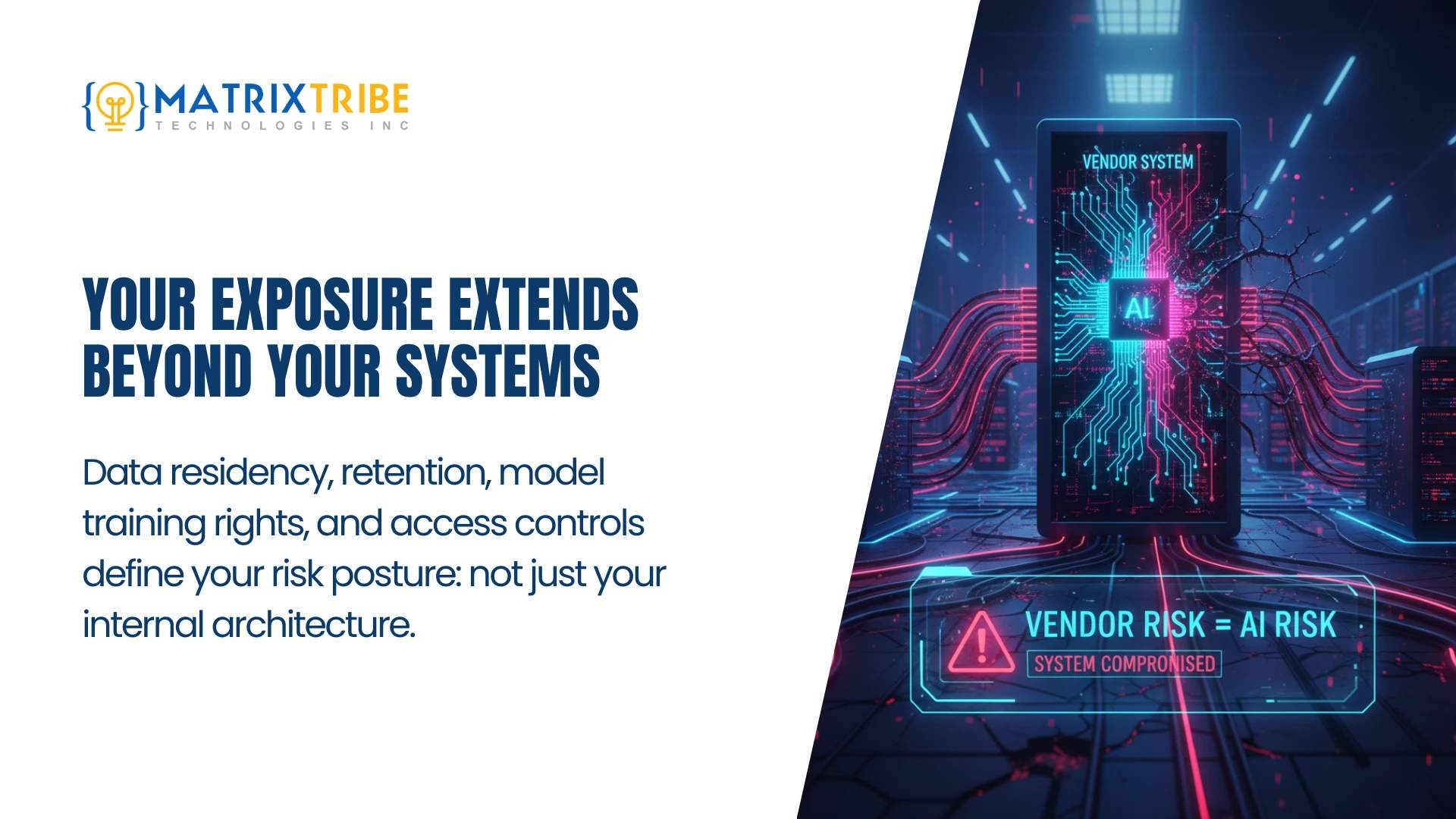
Vendor evaluation is a critical component of any AI risk management framework. AI risk does not stop at internal systems. A significant portion of enterprise exposure is inherited from third-party model providers, platforms, and embedded SaaS vendors. Governance fails quickly when vendor risk is treated as a procurement checklist instead of a control surface.
About 13% of organizations reported breaches involving AI models or applications, and of those, 97% lacked proper AI access controls, highlighting governance and security gaps that vendors must address.
Data Residency and Sovereignty
Enterprises must know where data is processed and stored, not just where a vendor is headquartered. Vendor contracts should explicitly define data residency options (e.g., US, EU, or customer-controlled regions) and prohibit silent cross-border processing.
Lack of residency control creates immediate regulatory exposure under GDPR, sectoral privacy laws, and emerging AI regulation, especially for global organizations.
Data Retention and Deletion Rights
AI vendors often retain prompts, outputs, or logs by default. Governance requires explicit retention limits and enforceable deletion rights.
The ambiguity around retention quickly undermines audit defensibility. If deletion cannot be contractually enforced, data persistence must be assumed.
Model Training and Data Reuse
Enterprises must explicitly determine whether their data is used to train or fine-tune vendor models. Opt-out clauses must be contractual, not implied.
Without clear exclusion, proprietary or regulated data may enter shared training pipelines, a risk that cannot be reversed after the fact.
Security Certifications and Assurance
Vendor assurances must be verifiable, not marketing claims. SOC 2 Type II and ISO 27001 certifications establish baseline expectations for access control, monitoring, and incident response.
Where healthcare or government data is involved, HIPAA BAAs or FedRAMP alignment becomes mandatory, not optional. The absence of certifications should automatically elevate the vendor's risk classification.
Operational Reliability and SLAs
AI systems increasingly support operational and decision-critical workflows. Vendors must commit to 99.9%+ uptime SLAs, transparent incident reporting, and defined escalation paths.
Reliability failures are governance failures when AI becomes embedded in core processes
Vendor Lock-In and Exit Risk
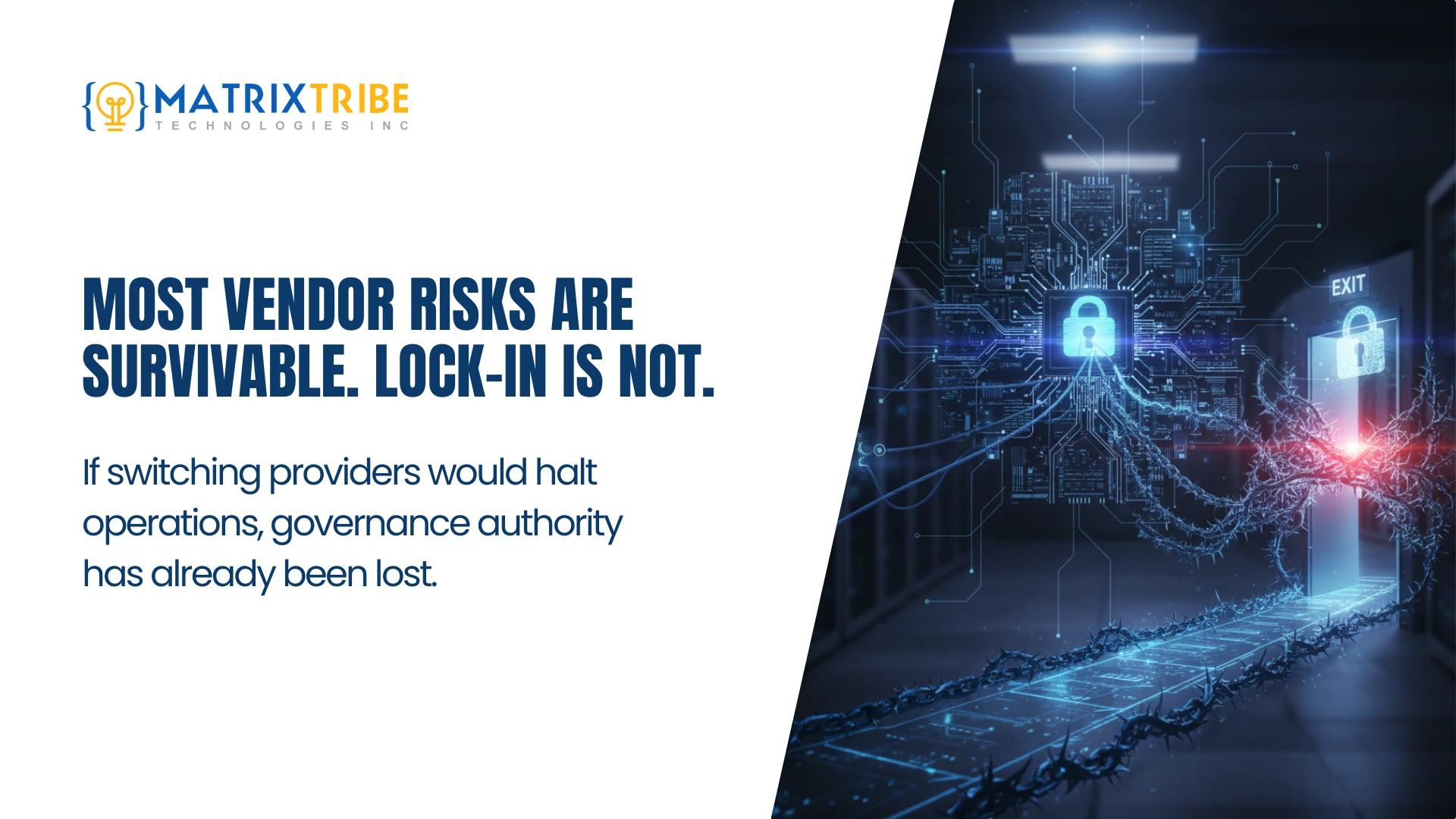
Vendor lock-in as a long-term strategic risk, not a technical inconvenience. Multi-provider strategies, abstraction layers, and portability planning reduce dependency on a single model or platform.
If switching vendors would halt operations, governance leverage has been lost.
Scoring Framework
Check | Item |
| SOC2 Type II or ISO27001 certification |
| Data residency controls (US or customer-controlled regions) |
| Opt out of model training |
| 99.9%+ uptime SLA |
| HIPAA BAA available (if handling healthcare data) |
The AI Vendor Selection & Evaluation Process
AI vendor selection is not a purchasing decision; it is a risk allocation and accountability decision. This stage operationalizes AI vendor risk assessment within the broader governance model.
Over 93% of organizations lack full confidence in securing AI-driven data, creating blind spots that structured risk registers and vendor due diligence are uniquely designed to close.
This process must be structured, staged, and governed, from requirements definition through production rollout.

In production environments, these risks rarely appear in isolation. Enterprises often encounter combinations of data exposure, unreliable outputs, and vendor dependency within the same system. The effectiveness of an AI risk management framework is determined by how well these risks are identified early and controlled before they compound at scale.
Conclusion
AI risk does not emerge at the moment of failure. It accumulates quietly as systems scale, vendors are added, and decisions move faster than oversight. By the time issues surface, data exposure, unreliable outputs, cost overruns, or regulatory scrutiny, the window for simple correction has already closed.
Enterprises that manage AI risk effectively do not rely on isolated controls or reactive fixes. They establish a visible risk register, apply consistent mitigation strategies, and treat vendor selection as a governance decision rather than a procurement exercise.
As AI systems become embedded in core workflows, risk management shifts from a technical concern to an executive responsibility. Organizations that act early retain control, flexibility, and credibility. Those who delay are left managing consequences instead of outcomes.
Responsible AI at scale is not about avoiding risk. It is about identifying it early, owning it explicitly, and designing systems that remain defensible as complexity grows.
Don’t Discover AI Risk After Deployment
AI risk is determined by early architecture, governance, and vendor decisions.
At MatrixTribe Technology, we design production-grade AI systems where risk registers, compliance controls, and vendor defensibility are built in, before scale removes your options. Talk to us before designing your AI systems.
Published

Latest Article
 July 1, 2026
Consistency in AI Governance: Why AI‑Assisted Development Needs Shared Standards
Read Article June 23, 2026
Access Control Before AI: The Governance Gap Inside Every Prompt
Read Article