
The 2025 Guide to Outsourcing Software Development for Faster Growth
August 26, 2025 / MatrixTribe

How can you meet aggressive release targets when your in-house team is already stretched thin, payroll keeps climbing, and specialty skills such as AI or cloud engineering are difficult to find? In 2025, every week of delay means another competitor moves ahead.
The solution is strategically outsourcing software development. It allows you to bypass hiring bottlenecks and access top-tier engineers on demand. Over 76% of the companies in the world outsource IT development to accelerate innovation. However, speed without structure introduces a different class of risk. Many outsourcing engagements fail not because of poor talent, but because of unclear ownership, inconsistent engineering standards, and a lack of system-level control. This is where most companies lose time rather than save it.
In this article, we will break down how outsourcing works, where it fails, and what it takes to make it reliable at scale.
What Is Software Development Outsourcing in 2025?
Software development outsourcing is the practice of collaborating with an external company to design, construct, and maintain applications or platforms. It allows you to leverage specialized expertise without increasing your in-house workforce.
In 2025, this strategy is about more than simply cost arbitrage; it's about strategic scalability, faster delivery, and access to scarce skills. But in practice, outsourcing is no longer just a resourcing decision. It is a system design decision. The way teams are structured, code is reviewed, and delivery is governed determines whether outsourcing accelerates progress or introduces long-term instability.
Outsourcing Models for Software Development in 2025
Choosing the right software development outsourcing model is critical to balancing cost, collaboration, and delivery speed. There are three modes of software outsourcing;
Nearshore or onshore outsourcing – Partnering with teams in neighboring or similar time zones to improve real-time collaboration while keeping travel and cultural barriers minimal.
Offshore outsourcing – Working with a dedicated development team in a different region, often at significantly reduced rates, to tap into global talent pools.
Hybrid models – A mix of onshore oversight with offshore execution. This balances cost, quality, and speed.
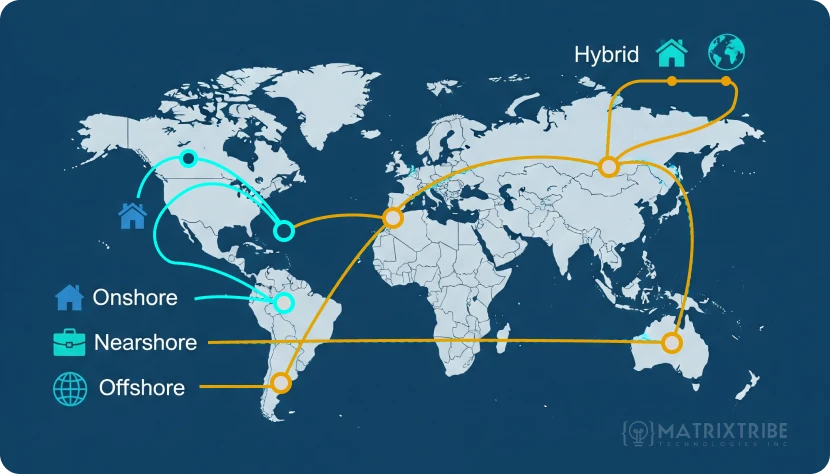
Whether you go nearshore, offshore, or hybrid, each approach has its own strengths, risks, and best use cases. Here is how they compare.
While these models are typically compared on cost and collaboration, the more critical distinction is control. As teams become more distributed, maintaining consistency in code quality, architecture, and delivery standards becomes harder without a structured engineering approach.
Model | Key Advantages | Best Fit For | Risks | Mitigation Strategies |
Nearshore / Onshore Outsourcing | • Easier communication and aligned working hours • Stronger cultural fit • Lower travel costs | Companies prioritizing close collaboration and immediate feedback loops. | • Higher hourly rates • smaller talent pool. | • Negotiate blended rates • Explore multiple nearshore regions to widen expertise options |
Offshore Outsourcing | • Significant cost savings • Access to rare skills • Flexible scalability | Businesses looking to reduce costs or access specialized expertise unavailable locally. | • Time zone gaps • cultural differences • communication delays | • Ensure overlapping work hours • Define clear SLAs • Use strong project management and async communication tools |
Hybrid Model | • Strategic cost control • Quality assurance via local presence • Flexible scaling | Mid-market and enterprise clients seeking a balance between budget and delivery quality. | • Higher management overhead • complex coordination between teams. | • Assign a local product owner or delivery manager • Implement integrated CI/CD and collaboration workflows |
How Do You Outsource Software Development
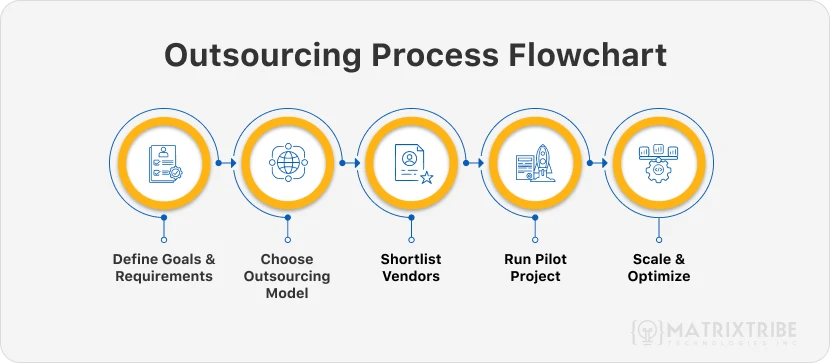
Outsourcing software development starts with defining your project scope, success metrics, and the capabilities you want from a software outsourcing provider. By following these guidelines, you will be able to successfully outsource software development:
Set objectives and requirements – Identify whether you need full-cycle development, staff augmentation, or a dedicated software development team.
Select your outsourcing model – Choose between onshore, nearshore, offshore, or hybrid models based on budget, time zone preferences, and collaboration style.
Shortlist vendors – Evaluate software development outsourcing companies for technical expertise, security compliance (e.g., SOC 2, GDPR), and proven case studies.
Run a pilot project – A small, time-bound engagement helps validate code quality, communication, and delivery speed before scaling up.
Establish governance and tools – Use CI/CD pipelines, version control, and observability dashboards to maintain transparency and quality. More importantly, define ownership, enforce consistent development standards, and ensure every output is traceable and reviewable.
The right partner will align with your culture, adapt to your tools, and bring proven frameworks that make outsourcing software development a growth lever rather than just a cost-saving tactic.
When and Why Should Companies Outsource?
Outsourcing software development is no longer just about cutting costs. In many cases, companies already move faster with outsourced teams, but struggle to maintain consistency and control as systems scale. Without clear governance, speed often leads to fragmented architectures and increasing technical debt due to vibe coding.
It's about accessing the right expertise, accelerating delivery, and staying competitive in a market where digital transformation moves fast. Whether you're a startup, scale-up, or established SME, the decision to outsource is often triggered by specific growth or capacity needs.
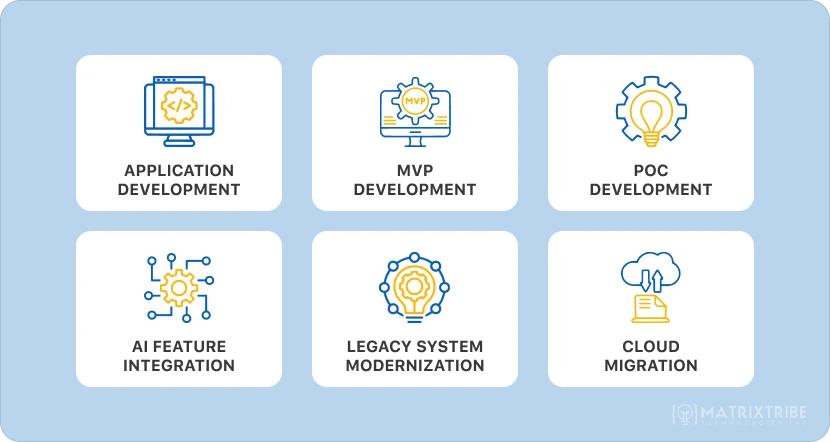
Here are common scenarios where outsourcing becomes a strategic advantage:
Building a new application from scratch – For companies without in-house engineering capacity, a software outsourcing company can take the complete application development project, ensuring clean architecture and future scalability.
Developing an MVP for investor demos – Startups often outsource MVP development to validate product-market fit quickly without committing to a large permanent team.
Creating a Proof of Concept (PoC) – Businesses exploring AI, blockchain, or other emerging tech can leverage outsourced development teams to test feasibility before full-scale investment.
Adding AI capabilities to existing platforms – Many software development outsourcing services specialize in integrating features like recommendation engines, AI chatbots, or predictive analytics without disrupting live operations.
Modernizing legacy systems – SMEs can work with custom software development outsourcing partners to migrate on-premises systems to cloud infrastructure or adopt API-first architectures.
When done strategically, outsourcing software development allows you to focus on your core business while ensuring projects are delivered on time, on budget, and to the highest technical standards.
The difference between successful and failed outsourcing is rarely the vendor itself. It is the presence of a structured system that defines how work is executed, reviewed, and maintained over time.
MatrixTribe's Approach to Future-Proof Outsourcing
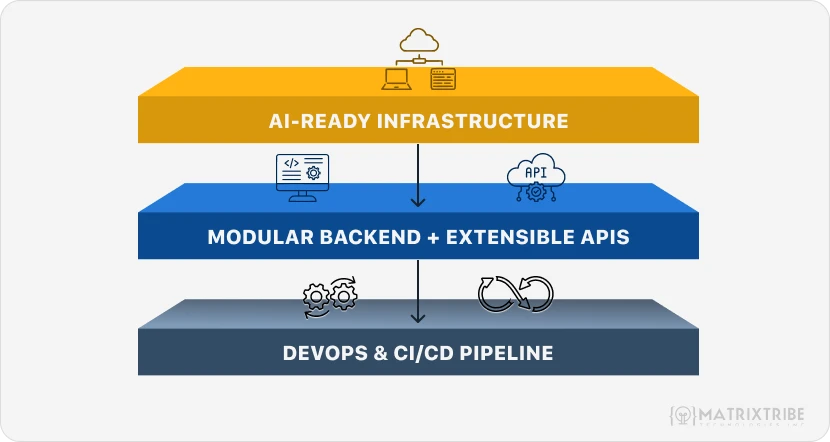
At MatrixTribe Technologies, we believe outsourcing software development should be more than a quick way to cut costs; it should be a catalyst for long-term growth. That's why our approach is designed to ensure your product is scalable, secure, and ready to adapt to emerging technologies. We don’t just deliver code; we build systems that are structured, observable, and designed for long-term reliability.
Moreover, we ensure that every build is designed with AI-ready infrastructure and a modular backend. So new features, integrations, and analytics can be added without costly rewrites.
Allow the wisdom of our tribe to become your lever for growth.
Frequently Asked Questions
Q. How much does it cost to outsource software development?
A. Costs vary widely based on project scope, complexity, and the location of your development partner. Rates can range from lower-cost offshore teams to higher-rate onshore specialists. A small MVP may require a modest five-figure budget, while complex, enterprise-grade systems can reach six figures.
Q. Should I outsource my MVP or build it in-house?
A. If time-to-market and budget efficiency are priorities, outsourcing an MVP is often the smarter move. It accelerates validation, avoids hiring delays, and lets internal teams focus on core business strategy or scaling later, once product-market fit is proven
Q. How do I ensure quality control when outsourcing?
A. Request regular progress demos, set clear acceptance criteria, and include detailed automated testing in contracts. Start with a small pilot to vet the team's processes and output before committing to full-scale development.
Final Words
The fastest-growing companies don't wait for perfect conditions; they build, test, and iterate with the right partners by their side. With the right software outsourcing company you can build systems that are scalable, reliable, and ready for real-world complexity. It is time you lower your development cost and build a system with the specialized skills of an outsourced developer.
Whether you're validating an idea with an MVP, modernizing legacy systems, or integrating AI capabilities, the right outsourcing partner will turn technology from a bottleneck into a competitive advantage.
Your Fast-Track to Launch Starts Here
Stop losing time to hiring delays and tech bottlenecks. Book your free strategy session with MatrixTribe now, and let's map out a clear, cost-efficient path to launch. One call could save you months of guesswork.
Published

Latest Article

 July 7, 2026
Explainable AI in Software Development: Why Every Output Needs a Trail
Read Article July 1, 2026