Why AI Governance Cannot Wait: From Shadow AI to Board-Level Accountability
January 29, 2026

AI is already being used across enterprises, often without formal approval, visibility, or accountability. Employees rely on public AI tools for daily work, teams experiment with internal agents, and vendors quietly embed AI into core systems. This activity is rarely malicious. It is usually driven by speed and productivity. But it creates a governance gap that is often underestimated at the executive level.
While AI-specific regulation remains fragmented and enforcement timelines are still unfolding, AI adoption is not waiting. Decisions about data use, automation, and accountability are already being made inside organizations, by default rather than by design.
This article examines why AI governance must be established now, before AI becomes embedded at scale and accountability becomes difficult to reclaim.
The Rise of Shadow AI Inside Enterprises
Shadow AI refers to the use of AI tools, models, or capabilities inside an organization without formal approval, visibility, or governance from leadership, IT, security, or legal teams.
Recent data reinforces how widespread and invisible this activity has become. An estimated 90% of enterprise AI usage now occurs outside the awareness of IT and security teams, while 57% of employees admit to concealing their AI use from managers. At the same time, 63% of organizations report having no formal AI governance policies in place, allowing shadow AI to expand without structural oversight.

What Shadow AI Looks Like in Practice
Shadow AI shows up in ordinary, easily overlooked ways. Employees use public AI tools to draft emails, analyze spreadsheets, or summarize internal documents. Teams build lightweight AI agents to automate reporting or operational tasks without routing them through IT or legal review. Software vendors introduce AI-driven features into platforms that already sit inside core business workflows.
Individually, these actions feel small. Taken together, they create an expanding surface area of AI activity that was neither explicitly approved nor fully understood.
Why Shadow AI Is a Governance Failure, Not an Employee Problem
Shadow AI is often framed as a misuse issue or a policy violation. In reality, it reflects a lack of structure. When organizations do not provide clear guidance, ownership, or decision paths for AI use, employees fill the gap themselves.
The absence of governance means there is no shared understanding of what is acceptable, no named owners for AI outcomes, and no escalation path when something goes wrong. Responsibility becomes diffuse, and accountability disappears. Over time, agentic AI stops being “shadow” at all; it simply becomes embedded, unmanaged infrastructure.
What makes shadow AI uniquely risky is that AI systems are not inert tools. Conversations, prompts, and uploaded files can be stored, retained, or used for model improvement depending on the provider. Even when no obvious personal data is shared, a sensitive business context can still be exposed.
Why AI Governance Cannot Wait for Regulation
Many executive teams assume AI governance will become clearer once regulation matures. In practice, this assumption delays decisions that are already being made every day across the organization.
Regulatory Immaturity Is the Current Reality
AI-specific regulation is still fragmented, and enforcement timelines are unfolding slowly. In some regions, requirements remain undefined; in others, enforcement is years away. There is no single, unified regulatory standard that enterprises can rely on today to govern AI use comprehensively.
This leaves organizations operating in a gray zone, expected to act responsibly, but without a finalized rulebook to follow.
The Risk of Waiting
While regulation evolves, AI adoption continues. Tools are selected, data is shared, and workflows are automated, often without centralized approval. When governance is postponed, decisions default to individuals and teams rather than leadership.
The impact of this delay is already visible. Nearly 70% of organizations cite AI-powered data leaks as a top risk concern, and the average enterprise now reports approximately 223 generative-AI-related data policy violations per month. These are not isolated incidents; they are signals of unmanaged AI operating at scale.
Over time, this creates compounding risk. AI usage becomes normalized without documentation, accountability, or review. By the time governance is introduced, it must undo habits and systems that are already embedded. Waiting does not reduce risk; it shifts it into harder-to-control forms.
The Foundations of an Enterprise AI Governance Framework
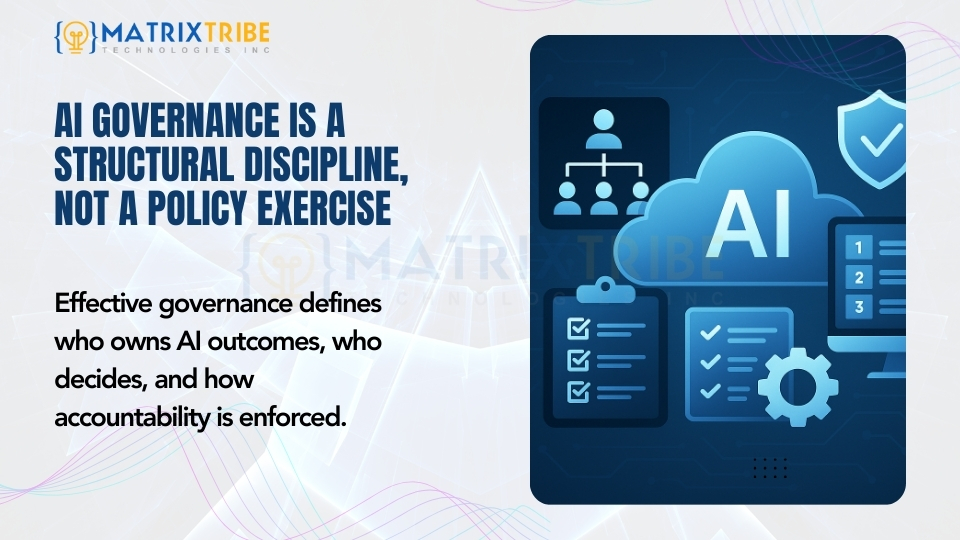
An enterprise AI governance framework is not a policy library or a compliance exercise. It is the structure that determines how AI decisions are made, owned, and defended across the organization.
What an AI Governance Framework Actually Establishes
At its core, an AI governance framework answers a small set of critical questions. Who owns AI outcomes? Who has the authority to approve or reject AI use cases? Who is accountable when an AI system fails, causes harm, or creates unintended consequences?
When these questions are answered explicitly, AI decisions stop being informal and start being intentional. Ownership becomes clear, escalation paths exist, and leadership can trace how and why decisions were made. This clarity matters far more than the volume of documentation produced.
A functioning governance framework also creates consistency. Similar AI use cases are evaluated the same way, risks are assessed against shared criteria, and decisions do not depend on which team happens to be involved.
What Happens Without a Governance Framework
Without a framework, organizations may still talk about AI responsibility, but they cannot enforce it. Incidents lack clear owners. Decisions cannot be reconstructed. Accountability becomes fragmented across teams that were never empowered to carry it.
In these environments, governance exists only in hindsight. Controls are added after problems surface, and leadership is forced into reactive decision-making. Over time, this erodes confidence, not only in AI systems, but in the organization’s ability to manage them.
Designing an AI Governance Committee That Works
An AI governance framework only works if there is a formally empowered group responsible for applying it. Without this, governance exists on paper while decisions about designing agentic AI continue to be made informally across the organization.

Why a Governance Committee Is Necessary
In the absence of a governance committee, AI decisions default to convenience. Tools are adopted where they are easiest to deploy, not where they are safest or most appropriate. Over time, this allows shadow AI to expand while leadership remains unaware of how deeply AI is embedded into workflows.
A governance committee provides a visible mechanism for ownership. It signals that AI decisions are leadership decisions, not individual or departmental experiments.
What an AI Governance Committee Is Responsible For
An effective governance committee is not advisory. It has decision authority. Its responsibilities include maintaining visibility into AI systems in use, approving or rejecting proposed AI initiatives, and owning escalation paths when AI-related issues arise. It is also responsible for ensuring that decisions are documented and defensible, particularly as AI usage scales.
Just as importantly, the committee defines who is accountable when something goes wrong. Without this clarity, incidents trigger confusion rather than a response.
Governance Requires Authority, Not Just Participation
Committees without authority do not govern. When a governance body lacks the ability to approve, block, or pause AI initiatives, it becomes a discussion forum rather than a control mechanism.
Governance must be supported by a clear mandate, defined decision rights, and an operating cadence that keeps AI usage visible and reviewed. Without these elements, organizations may believe they have governance in place while risk continues to accumulate unnoticed.
Decision Rights Matter More Than Policies
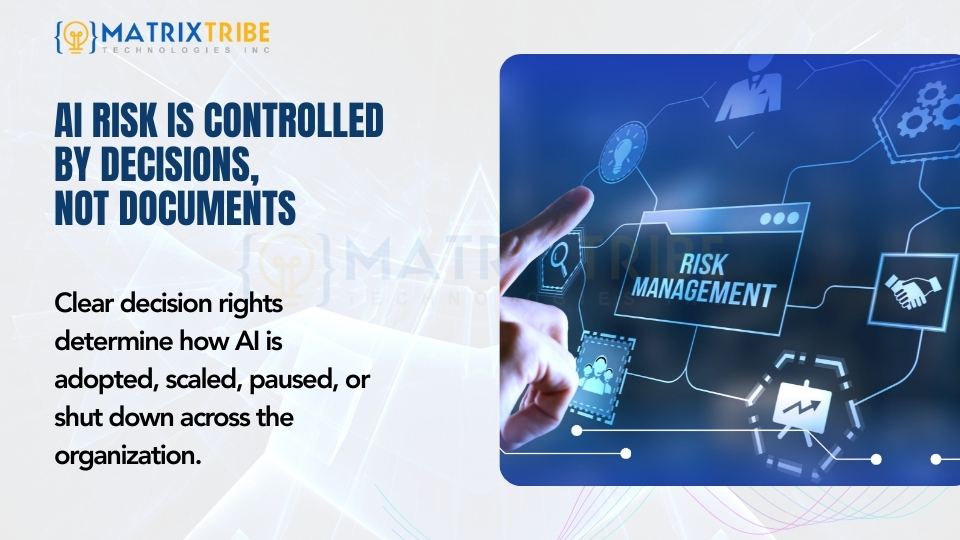
Policies describe intent, and decision rights determine behavior. In AI governance, clarity about who can decide is far more important than the number of rules an organization publishes.
Why Decision Rights Are Central to AI Governance
When decision rights are unclear, AI governance fails quietly. Teams move forward based on assumptions, approvals happen informally, and accountability only becomes a concern after an issue surfaces. At that point, it is often unclear who had the authority to decide in the first place.
Decision rights in AI governance extend beyond technical approval. This authority also includes budget control and vendor selection. Without this, organizations risk impulsive adoption of AI tools based on convenience or enthusiasm rather than fit, risk posture, or long-term accountability.
Establishing Accountability Through Clear Ownership
Clear decision rights also establish accountability. When ownership is explicit, AI outcomes, positive or negative, can be traced back to named roles rather than diffused across teams.
This is especially important as AI systems begin to influence business-critical workflows. Without defined ownership, incidents trigger an investigation instead of a response. With it, organizations can act decisively because responsibility is already understood.
Avoiding Governance Bottlenecks
When every AI decision requires excessive approval layers, governance becomes a blocker rather than an enabler. Effective decision rights balance control with momentum. They ensure leadership retains visibility and authority over AI use while allowing teams to operate within clearly defined boundaries. The goal is not to slow AI adoption, but to ensure it happens deliberately and defensibly.
The AI Governance Operating Model
Governance does not work as a one-time setup. It only works if it is embedded into how decisions are made over time. Without an operating model, governance structures lose relevance, and visibility fades.
Governance Is Ongoing, Not One-Time
There is a clear distinction between establishing governance and operating it. Initial frameworks and committees create structure, but they do not sustain oversight on their own. AI usage changes continuously as new tools, use cases, and vendors are introduced.
An effective operating model ensures that governance keeps pace with this change. It defines how often AI initiatives are reviewed, how exceptions are handled, and how emerging risks are surfaced before they escalate.
Establishing a Realistic Governance Cadence
Cadence is what keeps governance alive. Regular review cycles ensure AI usage remains visible and decisions remain intentional. Just as important are clearly defined escalation paths for urgent issues, where leadership can intervene quickly when risks emerge.
Governance meetings do not need to be frequent, but they must be consistent. Early on, a tighter cadence helps establish discipline and shared expectations. Over time, cadence can evolve, but it should never disappear.
Without an operating cadence, governance becomes episodic. AI decisions continue, but oversight becomes reactive rather than deliberate.
What Leaders Should Do in the First 90 Days
The first 90 days of AI governance determine whether structure takes hold or remains aspirational. This period is less about perfection and more about establishing visibility, ownership, and discipline early.
Immediate Priorities
The three actions leaders should focus on first.
Start by identifying where AI is already being used across the organization. This includes employee tools, internal experiments, and AI features embedded in vendor platforms. Visibility is the foundation for every governance decision that follows.
Next, assign ownership. Every AI system or use case should have a named owner responsible for outcomes and escalation. Without ownership, governance cannot function.
Finally, establish governance cadence. Set regular forums where AI usage is reviewed, decisions are documented, and issues are escalated. The goal is to make AI governance part of the normal operating rhythm, not an exception.
Why the First 90 Days Matter
Early governance prevents shadow AI from becoming institutionalized. It creates accountability before AI use expands further and before decisions become difficult to reverse.
Just as importantly, early action signals that AI decisions are leadership decisions. When governance is established early, organizations retain control as AI scales. When it is delayed, control is far harder to reclaim.

Final Words
AI governance is no longer a future concern. It is a present requirement.
AI is already embedded in enterprise workflows, often ahead of formal approval or oversight. Regulation will continue to evolve, but governance cannot wait for clarity that arrives later. Every delay increases the number of unmanaged decisions, undocumented systems, and unclear accountability.
The organizations that retain control are not those with the most policies, but those that establish ownership early, define decision rights clearly, and operate governance consistently. Governance is the foundation that allows AI to scale responsibly, without slowing progress or creating hidden risk.
Before compliance frameworks, before production deployment, and before AI becomes irreversible, governance must exist by design, not by accident.
Move From Unmanaged AI to Executive Accountability
At MatrixTribe Technologies we work with enterprises to design governance-aware AI and data systems that scale responsibly. We help leadership teams move from unmanaged AI usage to clear ownership, defensible decision-making, and production-ready intelligence pipelines, without slowing execution.
If your organization is already experimenting with AI and needs structure before scale, let’s start a conversation.
Published

Latest Article

 August 4, 2026