
Explainable AI in Software Development: Why Every Output Needs a Trail
July 7, 2026 / MatrixTribe
Explainable AI is not only about how a model makes a decision. In software development, it also means knowing how AI was used inside the workflow.
AI can help developers create code, tests, documentation, and workflows faster. However, speed creates risk when nobody can explain where the output came from, who approved it, or why it moved into production.
That is why Explainability is the final principle in the GRACE Framework. It creates a clear trail for AI-assisted work: what was generated, who used it, which prompt created it, who reviewed it, and why it moved forward.
The Explainability Gap: No Audit Trail After Production
Many organizations use AI tools before they define how to track the work. As a result, AI-generated code can enter a system with no clear record behind it.
A developer can use AI to create a function, edit the output, and add it to the codebase. Later, if that function fails, the organization needs answers. Who generated it? Which prompt created it? What model was used? Who reviewed it? Why was it accepted?
Without an audit trail, those answers become hard to find.
An AI audit trail records the important details behind AI-assisted work. It should show the input, output, model or tool used, reviewer, approval, and final decision. This record gives the organization evidence instead of guesswork.
Why “A Prompt Did It” Is Not an Answer
A prompt is not a complete explanation. It can show what someone asked AI to do, but it does not prove that the output was safe, reviewed, or ready for production.
For example, an auditor does not only need the prompt. They need to know who used the prompt, what AI returned, what changed after review, and who approved the final output.
Therefore, explainability needs more than prompt history. It needs human accountability.
A good record should answer five questions:
What did AI generate?
Who used or accepted it?
Which prompt created it?
Who reviewed it?
Why did it move forward?
Why Explainable AI Matters in Software Governance
Explainable AI helps people understand and trust AI outputs. In software development, that trust depends on evidence, especially when AI-assisted work affects code, data flows, customer information, or production systems.
The NIST AI Risk Management Framework also connects AI governance with trustworthy design, development, use, and evaluation. For software teams, that means AI output should not only work. It should be understandable, reviewed, and traceable.
If an AI-generated change breaks in production, the organization needs to trace the decision. If a customer asks how a feature works, developers need to explain the logic. If an auditor asks who wrote or approved a change, “AI generated it” is not enough.
This is why explainable AI matters in governance. It helps connect AI output to human decisions.
Also, explainability supports the earlier GRACE principles. Developers first need to Grasp the system. Then they need to control what AI can Access. After that, they need structured Review. Finally, they need Consistency across prompts, outputs, and documentation.
This also connects explainability to data governance frameworks, because AI-assisted decisions should show what data was used, how it was handled, and who approved the output before it entered the system.
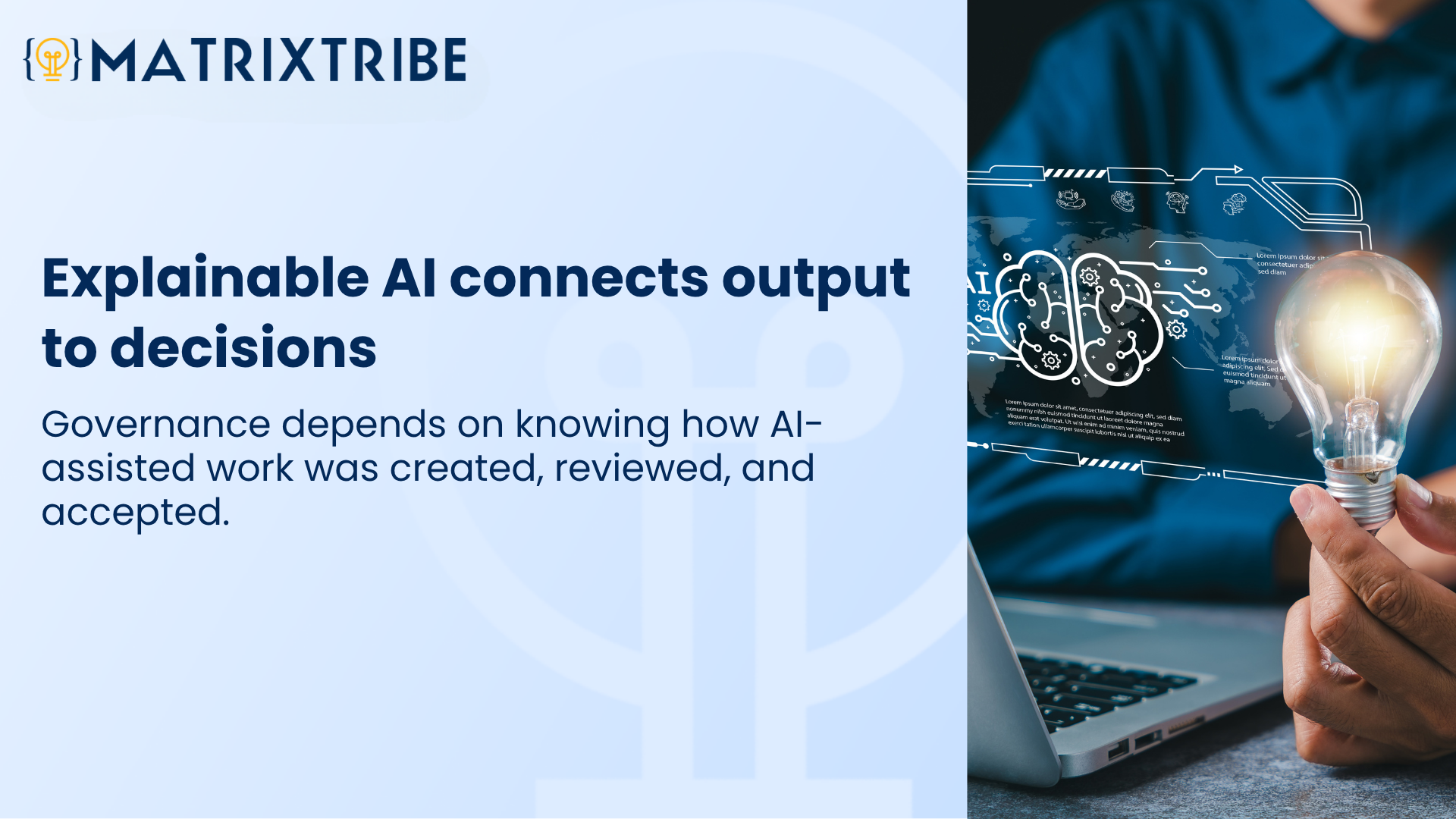
What Explainability Means in the GRACE Framework
In the GRACE Framework, Explainability means every AI-assisted output leaves a clear record.
The goal is simple. If AI helped create something, the organization should know what happened, who made the decision, and why the work moved forward.
Track What Was Generated
First, record the AI output.
This can include code, tests, documentation, scripts, summaries, or workflow changes. The record should show what AI created before developers changed or approved it.
This helps during review. It also helps later if the output causes a defect, security issue, or support problem.
Track Who Used or Accepted It
Next, record the human owner.
AI can generate output, but it cannot take responsibility for production. A developer, reviewer, or technical lead must own the decision to use the output.
This creates accountability. It also makes follow-up easier when questions appear later.
Track Which Prompt Created It
The prompt matters because it gives context.
It shows what the developer asked for, what assumptions were included, and what limits were given to the AI tool. However, the prompt should not stand alone. It should sit beside the output, review notes, and approval record.
Together, these details make the work easier to explain.
Track Who Reviewed It
AI-generated work needs human review before it moves forward.
The record should show who reviewed the output and what they checked. For example, they can review security, logic, architecture fit, data handling, and maintainability.
This turns review into evidence. It also shows that the organization did not accept AI output blindly.
Track Why It Moved Forward
Finally, record the reason for approval.
The reason can be simple. The output matched the requirement. The reviewer checked the logic. The code followed architecture standards. The risk was understood.
This step matters because auditors and future developers need context, not just a timestamp.
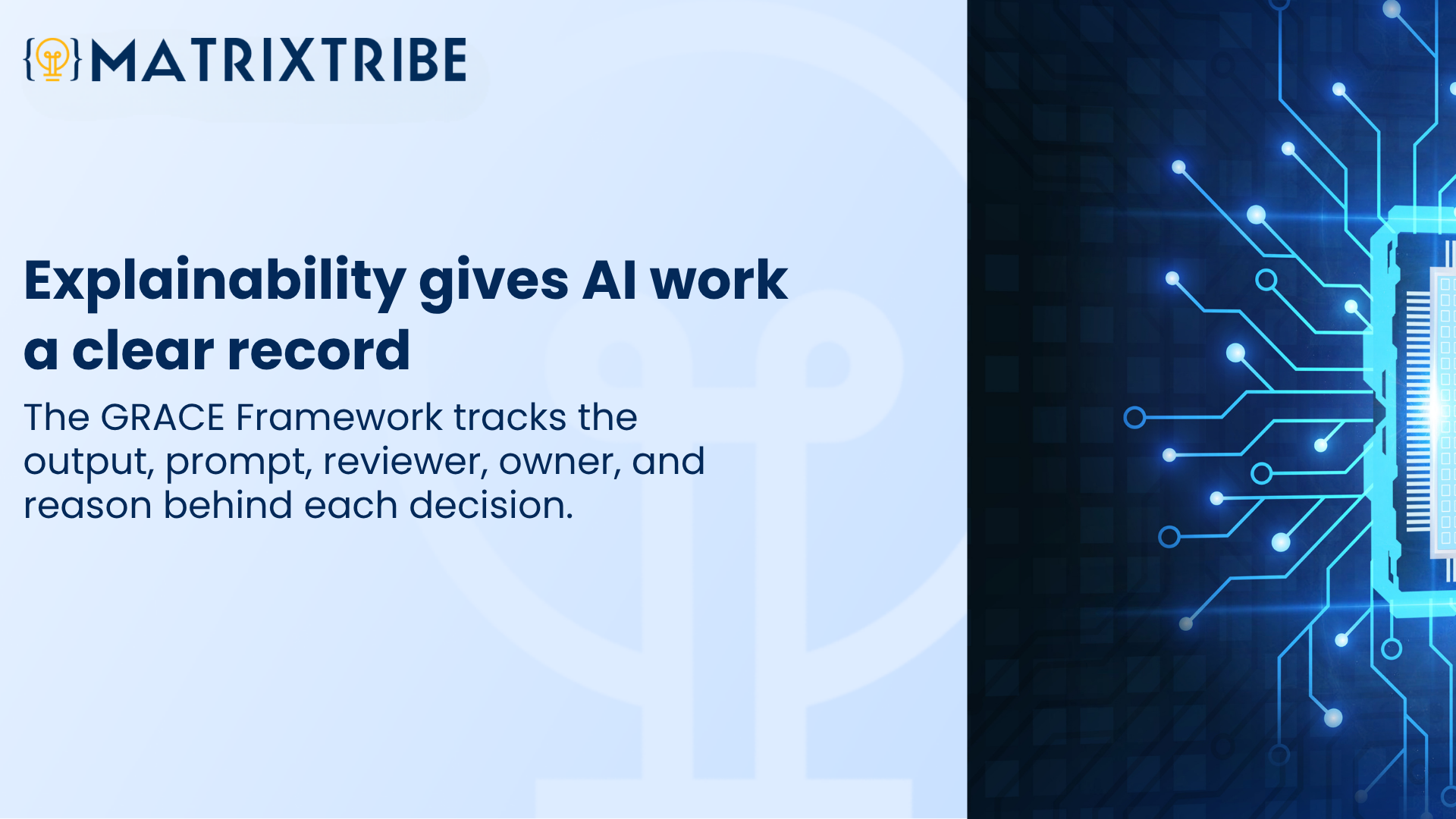
Why Traceability Speeds Up Incident Response
When there is an incident, the first step is to identify where it first occurred and that is exactly what AI governance ensures. Without a clear trail, developers have to search through commits, prompts, notes, and tool history. That slows incident response. It also creates confusion during high-pressure production issues.
When you follow the rules of explainability through the GRACE framework you ensure traceability of your decisions. Developers can see what AI generated, who reviewed it, what changed, and why the output was accepted.
As a result, they can find the source of the issue faster. They can also explain the incident more clearly to leadership, customers, or auditors. Traceability does not prevent every issue. However, it helps the organization respond with control instead of panic.
Frequently Asked Questions
Q. What is explainable AI in software development?
A. Explainable AI in software development means AI-assisted work can be traced and explained. The organization should know what AI generated, which prompt created it, who reviewed it, and why it moved forward.
Q. Why is an audit trail important for AI-generated code?
A. An audit trail helps developers and leaders understand how AI-generated code entered the system. It records the prompt, output, reviewer, approval, and owner. As a result, the organization can respond faster during audits, incidents, and production issues.
Q. Why is a prompt not enough for explainability?
A. A prompt only shows what someone asked AI to do. It does not show whether the output was correct, reviewed, changed, or approved. Explainability needs the full trail, including the prompt, output, review, decision, and human owner.
Q. Which competency focuses on communicating clearly with AI systems about what you want, how you want it done, and how you want to interact?
A. That competency is prompt engineering. In AI-assisted software development, prompt engineering helps developers give clear instructions to AI tools, define the expected output, set limits, and explain the context. In the GRACE Framework, prompt engineering supports explainability because a clear prompt makes the final output easier to trace, review, and understand.
Conclusion
AI-assisted development cannot rely on trust alone rather it needs evidence. Explainability gives that evidence. It helps organizations show what AI created, who reviewed it, and why the work became part of the system.
This is why Explainability closes the GRACE Framework. Grasp creates understanding. Access protects sensitive context. Review checks the output. Consistency keeps work aligned. Explainability leaves the trail.
Build AI Workflows With Explainability and Traceability
At MatrixTribe, our engineers build AI-driven applications, data platforms, and automation workflows with traceability from the start. We track prompts, outputs, reviews, and ownership so AI-assisted work stays explainable in production. Contact us if you want AI-speed development with clear accountability.
Published

Latest Article
 July 7, 2026
Explainable AI in Software Development: Why Every Output Needs a Trail
Read Article July 1, 2026
Consistency in AI Governance: Why AI‑Assisted Development Needs Shared Standards
Read Article June 23, 2026