
Access Control Before AI: The Governance Gap Inside Every Prompt
June 23, 2026

AI governance is not only about what AI generates. It is also about what AI is allowed to access.
In AI-assisted development, prompts can include API keys, customer data, business logic, internal workflows, and system details. Without AI risk management framework, sensitive project context can enter AI tools before anyone has defined what belongs in a prompt.
That is why Access Control is a core principle in the GRACE Framework. Before AI touches a project, organizations need clear rules for what can be shared, what must be protected, and who is allowed to use AI inside the development workflow.
The Access Control Gap: AI Touches Sensitive Context Without Policy
AI-assisted development creates risk when sensitive context enters a prompt without clear rules.
A developer can paste code, logs, credentials, customer scenarios, database details, or internal workflows into an AI tool to get a faster answer. The intent is productivity, but the exposure can be serious when there is no policy behind that action.
The issue is not only what AI generates. The issue is what AI is allowed to see.
API keys, business logic, and customer data should never move through AI workflows without defined access controls. When organizations skip this step, the risk becomes legal, reputational, and operational.
Why Prompts Become an Access Control Problem
A prompt is not always a simple instruction. In AI-assisted development, it can carry sensitive project context.
Developers use prompts to explain bugs, share code snippets, describe workflows, paste logs, or ask for help with system behavior. In that process, confidential information can enter an AI tool without being treated as access-controlled data.
That information can include credentials, architecture details, customer scenarios, internal business rules, or production error logs. Once it enters the prompt, the organization has already created a point of exposure to LLM application security risks.
This is why prompt use needs governance. Before developers share context with an AI tool, they need clear rules for what can be included, what must be masked, and what should never leave the internal environment.
Why Data Policy Must Come Before AI Touches the Project
Access Control in the GRACE Framework starts with one rule: data policy before AI touches the project.
Before developers use AI inside a workflow, the organization needs to define what information can be shared, what must be masked, and what should never enter a prompt. Without that clarity, every prompt becomes a judgment call.
A proper data policy should define which environments AI can access, which tools are approved, who is allowed to use them, and what requires review before sensitive context is shared.
This matters because AI-assisted development often sits close to the most valuable parts of a system: source code, customer data, business rules, APIs, and production issues. Access cannot be decided at the moment a developer needs a faster answer. It has to be defined before the work begins.
What Access Control Means in the GRACE Framework
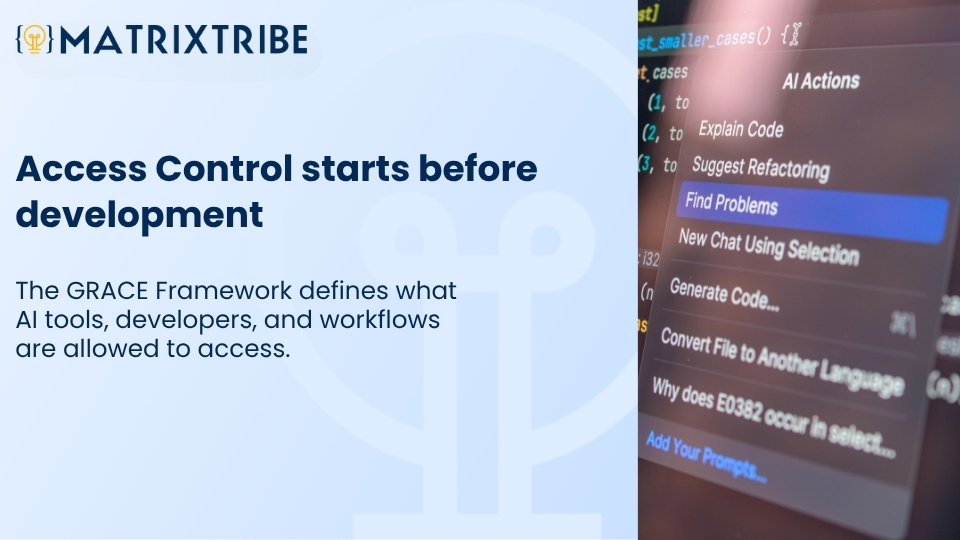
Access Control means setting clear rules for what AI tools, developers, and workflows can access before AI-assisted development begins.
It is not only a security setting. It is a governance practice that defines how sensitive project context moves through the development workflow.
Control Access to Credentials
API keys, tokens, secrets, and environment variables should never enter prompts. These details give access to systems, services, and data, so they need to stay inside controlled environments.
Control Access to Customer Data
Customer data should be protected, masked, or excluded unless approved governance rules are in place. Developers need to know when real data can be used, when synthetic data is safer, and when sensitive information should not be shared at all.
Control Access to Business Logic
Business logic can reveal how the organization operates. Pricing rules, fraud checks, approval flows, and proprietary workflows need clear boundaries before they are shared with AI tools.
Control Access to Development Environments
AI tools should not connect freely to repositories, databases, staging systems, or production environments. Access needs to be defined by role, use case, and risk level.
Control Access Through Approved Tooling
Organizations need approved AI tools, usage policies, audit trails, and role-based permissions. Developers should not have to decide on their own which tool is safe for sensitive project work.
Why Access Control Is a Legal and Reputational Risk
When sensitive context is shared with AI tools without controls, the damage is not limited to engineering. A prompt can expose customer data, credentials, proprietary workflows, or internal system details that should have stayed protected.
That creates risk across compliance, vendor management, customer trust, and executive accountability. Once sensitive information leaves a controlled environment, the question is no longer only whether the code works. The question becomes whether the organization can prove that its data, systems, and customers were protected.
Frequently Asked Questions
Q. What is access control in AI governance?
A. Access control in AI governance means defining what AI tools, developers, and workflows are allowed to access before AI-assisted development begins. It protects sensitive project context such as credentials, customer data, business logic, source code, and production information.
Q. Why do prompts create access control risk?
A. Prompts create access control risk because they often include more than a task. Developers can include code snippets, logs, system details, customer scenarios, or internal workflows. If those inputs are not governed, AI tools become another place where sensitive information can be exposed.
Q. What should organizations define before using AI in development?
A. Organizations should define what data can be shared, what must be masked, which AI tools are approved, who can use them, and which environments AI can access. These rules should be clear before developers use AI inside project workflows.
Conclusion
Access Control matters because AI-assisted development starts before code generation. It starts with the information developers give AI.
Before AI touches a project, organizations need clear rules for data, credentials, business logic, approved tools, and development environments.
Build AI Workflows With Access Control From the Start
At MatrixTribe, our engineers use AI-assisted development with clear access rules, data boundaries, and production controls before sensitive project context enters the workflow. Contact us if you want AI-speed development without exposing the logic, data, and systems your business depends on.
Published

Latest Article
 September 21, 2026
What SOC 2 Type II Actually Tells You About a Software Development Partner
Read Article September 14, 2026
How to Embed AI Into Existing Workflows Without Adding Friction
Read Article September 7, 2026