Model Context Protocol (MCP): The Enterprise AI Integration Standard
March 11, 2026
AI adoption is accelerating, but many initiatives stall for the same reason: integration. The limitation is no longer model capability; it’s how AI connects to systems, data, and tools.
Early approaches relied on plugins, function calling, and custom integrations. These worked for pilots, but they were never designed for agentic AI, systems that act across workflows and domains.
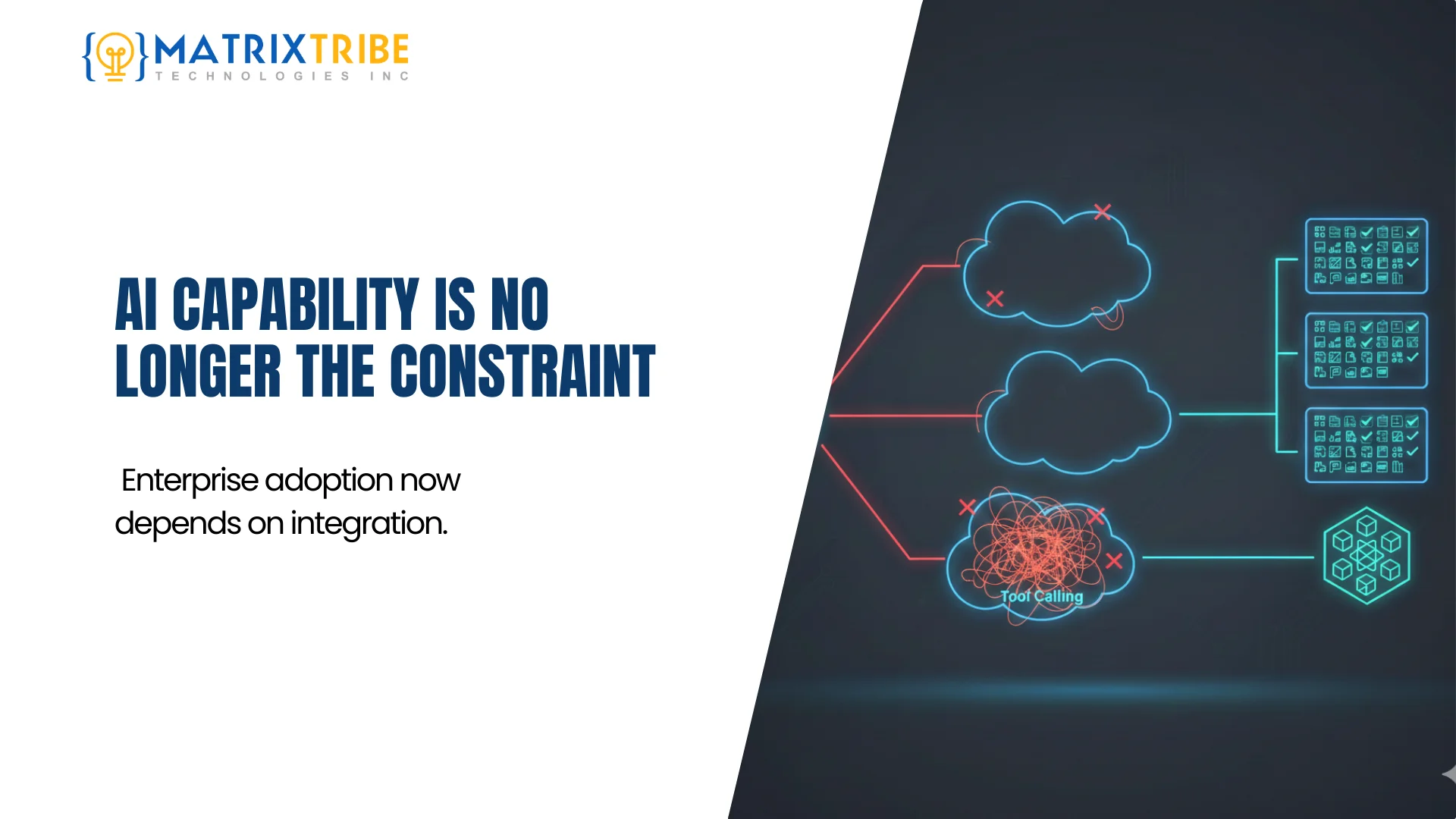
That gap is why Model Context Protocol is entering executive conversations. Not as a technical upgrade, but as a response to a strategic shift: AI strategy is now integration strategy. Nearly 78% of enterprise leaders report struggling to integrate AI with existing systems, showing that integration, not model quality, is the primary barrier to adoption.
This article explains why enterprises are rethinking how AI connects to real work, and what that means for leaders making long-term decisions.
The Old Integration Models: Plugins, Function Calling, and Tool Calling
Before agentic AI entered the picture, enterprises relied on a set of integration patterns to enable AI systems to interact with external tools and data. These models were effective for early experimentation, but they were not built to support AI as a persistent, system-level actor inside the organization.
Plugins
Plugins expose predefined capabilities to an AI system through fixed interfaces. The model selects a plugin, executes a specific action, and returns the result within a tightly scoped interaction.
Why do they break down at scale
Plugins are designed for single-purpose tasks and short-lived interactions. As the number of workflows grows, organizations accumulate fragmented plugins with inconsistent access rules and limited shared context.
Plugins scale features, not systems. Over time, they create a patchwork of capabilities that is difficult to govern, audit, or extend across the enterprise.
Function Calling
Function calling allows an AI model to invoke predefined functions based on structured inputs. Each function represents a discrete operation with clearly defined parameters and outputs.
Why does it break down at scale
As AI use cases expand, the number of functions grows rapidly. Context must be passed manually between calls, increasing complexity and making multi-step coordination brittle and error-prone.
Function calling ties AI behavior to custom logic embedded in applications. This creates long-term coupling between models and systems, increasing maintenance costs and slowing adaptation.
Tool Calling
Tool calling extends function calling by allowing models to dynamically choose from a broader set of tools. The AI selects a tool, executes it, and incorporates the result into its response.
Why does it break down at scale
Tool selection and execution logic remain distributed across workflows. Without a shared integration layer, behavior becomes inconsistent and difficult to oversee as tools proliferate.
Tool calling shifts complexity rather than eliminating it. Leaders lose clear visibility into how AI actions propagate across systems, increasing operational and governance risk.
AI Integration Models Compared: Plugins vs Custom Integrations vs MCP
Dimension | Plugins / Function & Tool Calling | Custom Integrations | Model Context Protocol (MCP) |
Primary Purpose | Enable quick, task-specific AI actions | Tailor AI behavior tightly to internal systems | Standardize how AI connects to tools and data |
How They Work | AI invokes predefined tools or functions within isolated workflows | AI logic is embedded directly into applications and processes | AI interacts with systems through a shared, standardized integration layer |
Speed to Deploy | High — ideal for pilots and experimentation | Medium — requires engineering effort | Medium — requires upfront design but reduces repetition |
Scalability | Low — each new use case adds isolated logic | Medium — scales with rising complexity and maintenance | High — capabilities are reused across AI systems |
Context Continuity | Limited — context handled per interaction | Inconsistent — depends on custom orchestration | Built for persistent, system-level context |
Governance & Oversight | Minimal — access rules vary by workflow | Fragmented — rules differ across integrations | Structured — consistent access boundaries possible |
Operational Risk | Hidden — fragmentation increases quietly | Accumulating — dependencies compound over time | Managed — integration risk is centralized |
Long-Term Cost | Low initially, high as usage grows | High due to maintenance and rework | Lower over time through reuse and standardization |
Strategic Fit | Short-term experimentation | Tactical control for a limited scope | Long-term enterprise AI infrastructure |
Why Integration Has Become a Strategic Question
As AI systems evolve from assistants into actors, integration is no longer a technical afterthought. It defines whether AI can operate reliably inside the business or remain confined to isolated use cases. 95% of IT leaders say integration issues are the biggest obstacle to scaling AI, yet fewer than 30% have fully connected systems
What Changed With Agentic AI
Agentic AI systems are expected to pursue goals, sequence actions, and adapt to changing conditions. This requires more than the ability to trigger individual functions or tools. It requires sustained context, coordinated access across systems, and predictable behavior over time.
Integration models designed for single-step interactions were not built for this shift.
Why Coordination Now Matters More Than Capability
Most enterprises already have capable models. The bottleneck is coordination:
how data is shared across workflows,
how actions are ordered and validated,
how outcomes are tracked across systems.
Without a coherent integration layer, AI capability fragments across departments and applications, limiting impact and increasing risk.
The Strategic Shift Leaders Must Recognize
Integration has moved from an engineering concern to a leadership decision. It determines:
how scalable AI initiatives can become,
how governable AI behavior is,
and how quickly the organization can adapt as requirements change.
At this stage, the question is no longer whether AI can be deployed, but whether the integration model can support AI within the operating model.
Enter MCP: A Standardized Integration Layer for Agentic AI
As enterprises confront the limits of plugins, function calling, and custom integrations, a different approach is beginning to take shape. The Model Context Protocol (MCP) has emerged to address a problem that existing integration models were never designed to solve: enabling AI systems to connect to real work in a consistent, scalable, and governable way.
What is Model Context Protocol?
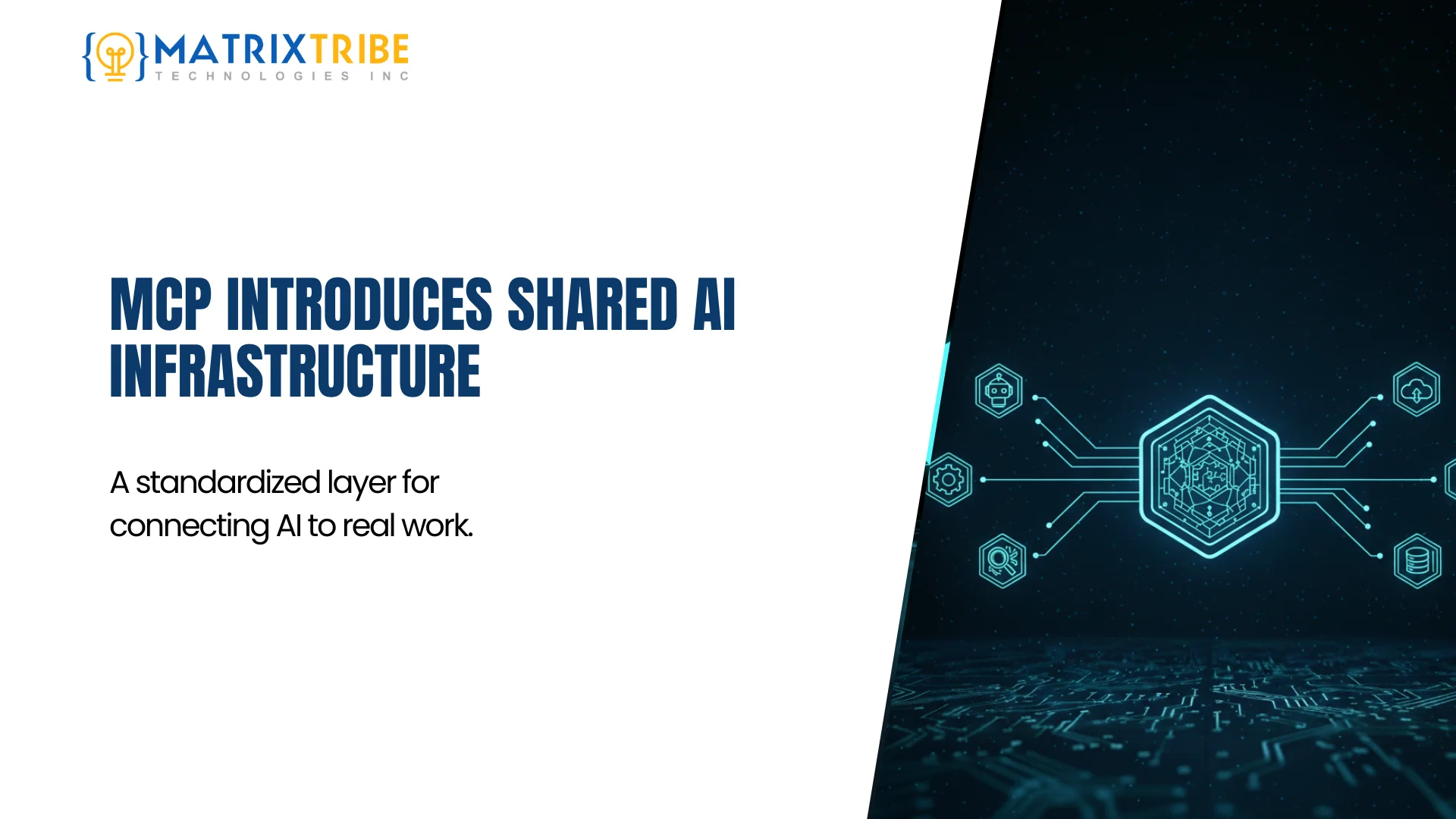
The Model Context Protocol is an open standard that defines how AI systems discover tools, access data, and interact with external systems through a consistent interface. Instead of embedding integration logic inside every application or workflow, MCP externalizes those connections into a standardized layer.
At a high level, MCP enables AI systems to understand which capabilities are available and how they can be used, without hard-coding integrations into each use case.
How MCP Changes the Integration Model
MCP separates AI reasoning from system connectivity. Tools and data sources are exposed through MCP servers, while AI systems interact with them through a uniform protocol. This creates a clear boundary between decision logic and execution.
As a result:
integrations become reusable across use cases,
access rules can be applied consistently, and
Behavior becomes more predictable across systems.
This is fundamentally different from earlier models, where integration logic was duplicated across workflows and applications.
MCP Is a Strategic Shift
MCP is not simply a more efficient way to connect tools. It represents a move toward treating AI integration as shared infrastructure rather than ad-hoc plumbing.
For leaders, this matters because standardized integration:
reduces long-term complexity,
enables governance without slowing innovation, and
allows AI capabilities to scale across the organization without multiplying risk.
In this sense, MCP is less about how AI works today and more about how AI can be sustained as it becomes embedded in core operations.
Why Standards Matter at This Stage of AI Adoption
Fragmentation Is the Cost of Early Adoption
In the early phase of AI adoption, speed mattered more than consistency. Organizations accepted fragmented integrations, duplicated logic, and uneven behavior because they enabled rapid experimentation.
That trade-off no longer holds. As AI systems move closer to core operations, fragmentation introduces friction, risk, and rising cost.
Scale Exposes the Limits of Non-Standard Approaches
When AI is deployed across multiple workflows and teams, the absence of standards becomes visible. Integration logic diverges, access rules differ, and behavior becomes difficult to predict or audit.
What worked for pilots becomes a constraint at scale.
Standards Enable Governance Without Slowing Innovation
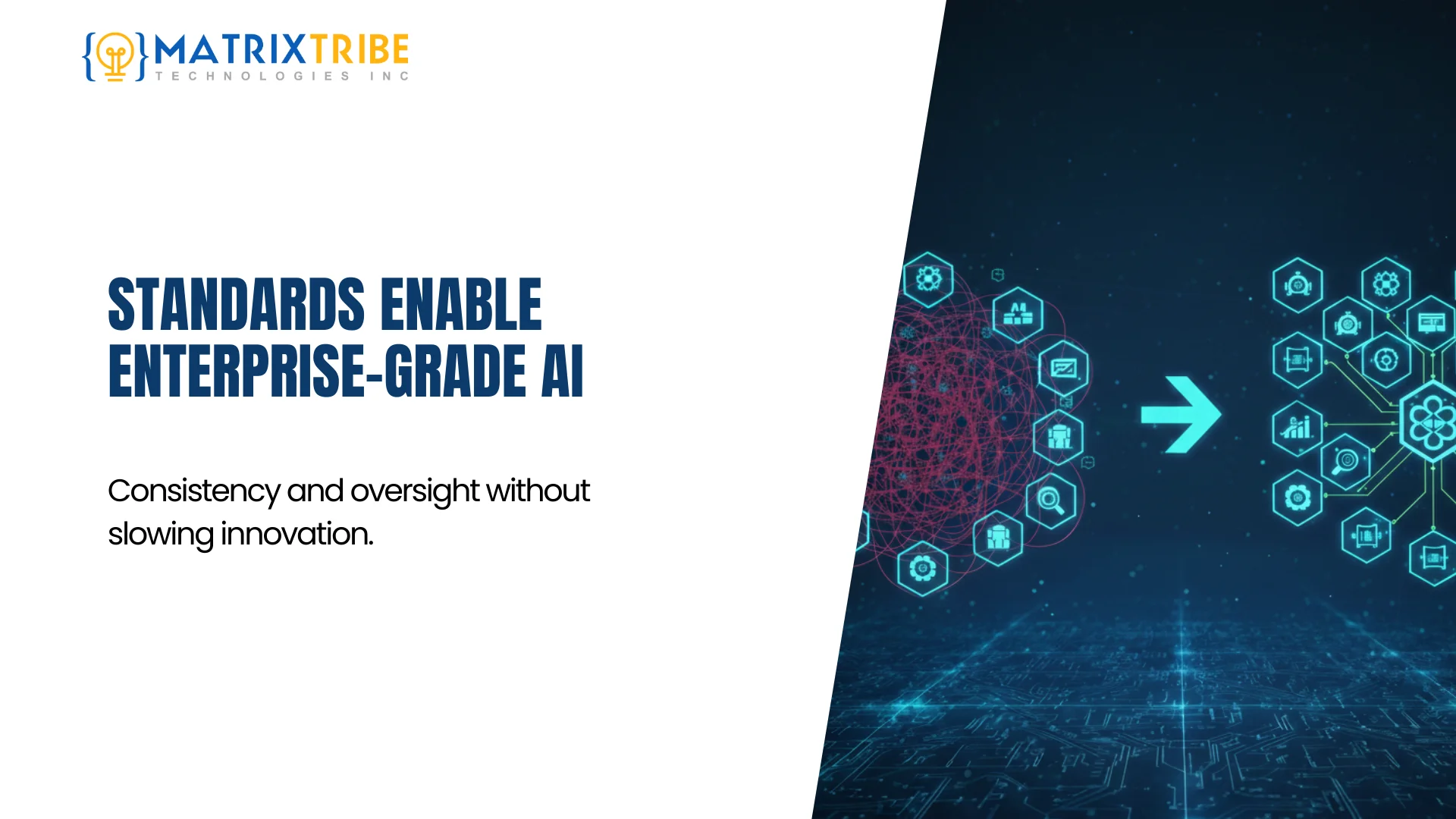
Standards do not restrict progress. They create shared rules that allow systems to interact consistently, define responsibilities clearly, and apply oversight without manual intervention.
This is what allows innovation to continue without compounding risk.
From Experimentation to Infrastructure
The emergence of integration standards signals a shift in maturity. AI moves from being a series of experiments to becoming part of the organization’s infrastructure.
At this stage, leadership focus shifts from speed of deployment to durability, governability, and trust.
Frequently Asked Questions
Q1. What is a Model Context Protocol?
The Model Context Protocol (MCP) is an open standard that defines how AI systems connect to tools, data, and services in a consistent way. It is designed to help AI systems interact with real-world systems without relying on fragmented plugins or custom integrations.
In practical terms, MCP standardizes how context and capabilities are exposed to AI, making integration more scalable and governable as AI systems become more autonomous.
Q2. What is MCP vs API?
A2. APIs define how applications communicate with each other. MCP defines how AI systems communicate with tools and data.
An API exposes a specific service or function. MCP sits above individual APIs and provides a standardized way for AI systems to discover, access, and use those capabilities without hard-coding integrations for each use case.
MCP does not replace APIs; it organizes and standardizes how AI interacts with them.
Q3. What is the difference between MCP and HTTP?
A3. HTTP is a low-level communication protocol used to transmit data between systems. MCP operates at a higher abstraction layer.
While HTTP defines how data is transported, MCP defines how AI systems understand available context and actions. MCP may use HTTP underneath, but its purpose is semantic coordination, not data transport.
In short: HTTP moves data. MCP structures AI interaction.
Q4. Is Model Context Protocol an API?
A4. No. MCP is not an API. MCP is an integration protocol that standardizes how AI systems interact with APIs, tools, and data sources. APIs remain the underlying mechanisms, while MCP provides the framework that makes those interactions consistent, reusable, and scalable across AI systems.
Final Words
Model capability will continue to improve. That is no longer the constraint. The real differentiator for enterprises will be how effectively AI connects to systems, data, and work. Plugins, function calling, and custom integrations were sufficient when AI lived at the edges of the organization. They are increasingly inadequate as AI systems become agentic, persistent, and operationally embedded.
The emergence of standards like the Model Context Protocol signals a broader shift: AI integration is moving from ad-hoc engineering to shared infrastructure. This is not a technical evolution; it is an organizational one. It affects scalability, governance, risk, and long-term adaptability.
Build the Right Integration Foundation for Agentic AI
Agentic AI will not scale with ad hoc plugins or brittle custom integrations. It requires a deliberate integration strategy, one that supports governance, flexibility, and long-term system evolution.
At MatrixTribe Technology, we help organizations design and build enterprise-grade AI integration foundations, so agentic systems can connect to real work safely, consistently, and at scale.
Published
Latest Article
 July 27, 2026