
How to Prioritize AI Use Cases Without Wasting Budget on the Wrong Ones
September 7, 2026

AI use case prioritization gets difficult when several ideas look valuable but differ sharply in readiness, cost, risk, and implementation effort. A use case that performs well in a pilot may still depend on weak data, complex integrations, expensive model usage, or governance controls that have not been designed yet. In enterprise environments, those production constraints can matter as much as theoretical business value.
A practical AI strategy compares opportunities across business impact, technical feasibility, readiness, cost, risk, adoption, and time to value. This article provides a structured way to make that comparison and turn the strongest opportunities into an enterprise AI roadmap.
Why AI Use Case Strategy Is Harder Than It Looks
AI use case strategy becomes difficult when ideas are evaluated in isolation. Business value, feasibility, readiness, and risk need to be considered together before budget is committed.
Too Many Opportunities Compete for Attention
AI ideas can come from leadership, business teams, vendors, or internal experimentation. Several may target the same problem through different approaches.
Without common evaluation criteria, organizations can fund overlapping pilots while the underlying business outcome remains unclear.
Technical Possibility Can Distort Business Priority
A convincing prototype can make a use case appear more valuable than it is. Technical feasibility shows whether an idea can work. Priority also depends on the value of the problem, implementation effort, operating cost, and whether a simpler approach can achieve the same outcome.
This matters even more with autonomous systems that interact with enterprise data, APIs, applications, and business workflows.
Early Pilots Often Hide Production Constraints
A pilot can work with controlled data and limited users. Production introduces integrations, identity and access controls, evaluation, monitoring, failure handling, and costs at real usage volumes.
The gap remains visible across enterprise adoption. McKinsey’s 2025 State of AI survey found that nearly two-thirds of respondents said their organizations had not yet begun scaling AI across the enterprise.
Those constraints can materially change whether a use case deserves investment. Our guide to scaling AI from pilot to production explores what changes once AI has to operate reliably, securely, and economically beyond a controlled experiment.
How an AI Readiness Assessment Should Influence Prioritization
An AI readiness assessment should show whether a use case can move now, needs prerequisite work, or should be deferred. A valuable opportunity can remain strategically important even when the organization is not ready to implement it immediately.
Data Readiness
Start with the data the use case actually needs. Assess whether it exists, who owns it, how reliable it is, whether the AI system can access it, and how frequently it must be updated.
A forecasting model built on incomplete historical data may require substantial preparation, while an assistant using governed internal documents may be much closer to deployment.
Fragmented data can also create dependencies that affect several initiatives at once. Consolidating access, governance, or data pipelines may therefore become foundational work for the wider AI portfolio.
Architecture and Integration Readiness
Next, assess what the AI system must connect to in production. Existing APIs, identity systems, cloud architecture, legacy applications, and workflow dependencies can significantly change implementation effort. An assistant retrieving approved documents has a much lighter architecture than an agent expected to read account data, update business systems, and trigger transactions.
A high-value opportunity may stay on the roadmap while API development, access controls, or platform modernization happen first.
Microsoft’s 2026 AI strategy guidance similarly connects use-case selection with data, architecture, security, responsible AI, skills, and budget. These factors shape whether an opportunity can realistically move toward adoption.
Governance and Operating Readiness
Readiness also depends on whether the organization can operate the system responsibly after launch.
Ownership, human approval, system access, monitoring, and failure handling should be clear before deployment. Higher-impact decisions and greater system autonomy usually require stronger controls.
Our analysis of why AI governance cannot wait examines what happens when AI adoption moves ahead of ownership, accountability, and operating controls. The outcome of a readiness assessment should clarify sequencing: pursue now, prepare first, defer, or stop.
How to Evaluate Which AI Use Cases Deserve Investment
AI use cases should be compared against the same business and implementation criteria. This makes the tradeoffs between expected value, feasibility, cost, risk, readiness, and adoption easier to see.
Business Value and Strategic Relevance
Start with the outcome the use case is expected to improve, whether that is revenue, operating cost, cycle time, customer experience, risk exposure, or team capacity.
Strategic relevance deserves separate consideration. A project may offer clear cost savings while contributing little to a core business priority. Another may take longer to pay back but strengthen a proprietary capability, important product, or customer experience.
Technical Feasibility
Technical feasibility should reflect whether the use case can perform reliably within the real workflow, including available data, integrations, latency, accuracy requirements, and system dependencies.
Acceptable error also varies by context. An internal drafting assistant can tolerate more uncertainty than a system that approves transactions, changes customer records, or takes actions across enterprise applications.
Time to Value
Time to value includes the prerequisite work required before the use case produces a meaningful business outcome.
Data preparation, API development, security reviews, workflow changes, and evaluation can extend that path considerably. Use cases that fit existing systems may reach useful deployment sooner than opportunities with similar business potential but heavier dependencies.
Cost and Resource Requirements
AI implementation costs extend beyond model or API usage. Engineering, data preparation, integrations, infrastructure, evaluation, monitoring, security, human review, maintenance, and change management all contribute to the investment.
Scale can change the economics quickly. Costs that appear minor during a pilot may look very different across thousands of users, documents, transactions, or automated actions.
Risk and Governance Burden
Sensitive data, regulated workflows, incorrect outputs, system permissions, and AI autonomy can increase the controls required around a use case.
The NIST AI Risk Management Framework provides a useful reference for considering AI risk and trustworthiness across design, development, deployment, use, and evaluation.
Priority should reflect whether the organization can manage the risks introduced by the specific use case at its intended scale and level of autonomy.
Adoption and Operational Fit
An AI capability also has to fit the way work is done. Training, workflow disruption, human oversight, process ownership, and integration with existing tools all influence adoption. Even a technically strong system can become a weak investment when employees have to work around it or responsibility for its outputs is unclear.
Compare the Tradeoffs Together
The difficult part is deciding how much each factor should matter for the organization making the investment.
A company focused on near-term efficiency may evaluate opportunities differently from one building proprietary AI capabilities. A regulated business may emphasize governance and control, while another may be constrained primarily by data readiness, engineering capacity, or time to value.
Evaluating the opportunities as a portfolio helps identify which use cases warrant deeper validation, which dependencies need attention first, and where further investment would be premature.
How to Choose the Right AI Implementation Strategy
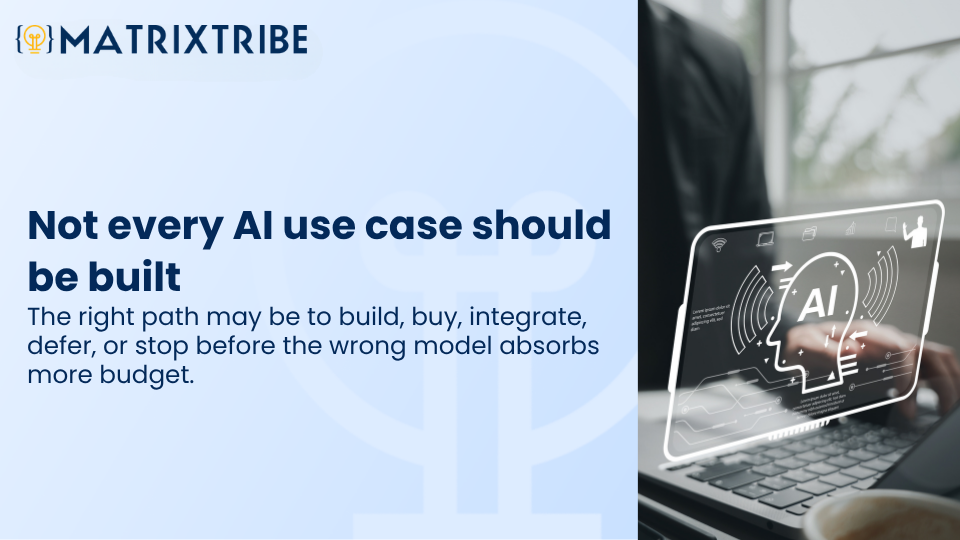
Once a use case earns priority, the organization still needs to decide how the capability should be obtained. Differentiation, speed, control, integration requirements, cost, and long-term ownership should shape that decision.
When to Build
Building makes sense when the capability depends heavily on proprietary data, distinctive workflows, or an area where control and differentiation have strategic value.
Custom development may also be justified when deep integration is required or existing products cannot meet security, performance, or operational requirements. Greater architectural control also creates responsibility for evaluation, monitoring, maintenance, and future model changes.
When to Buy
Buying can work well when vendors already solve the problem effectively and the capability offers limited competitive differentiation.
Speed is often the main advantage, although data handling, security, integration, pricing at scale, contractual restrictions, and vendor dependence still affect the long-term economics.
When to Integrate
Integration is useful when capable AI already exists within cloud platforms, enterprise software, or specialist products, while the real value comes from connecting it to proprietary systems and workflows.
This can reduce custom development while allowing the organization to control how the capability interacts with its data, applications, and business rules.
When to Stop or Defer
Some opportunities should be parked before they absorb more budget. Weak economics, unavailable data, excessive risk, unclear ownership, or a simpler alternative can make an AI use case a poor investment. Others may become viable once dependencies such as data access, integration, governance, or infrastructure have improved.
Stopping or deferring an initiative keeps engineering capacity and investment focused on opportunities with stronger conditions for success.
Compare the Full Lifecycle
Build-versus-buy decisions should account for more than upfront development cost. Strategic differentiation, speed, integration depth, control, maintainability, vendor dependence, and ongoing operating costs all influence the better path.
The appropriate approach is the one that delivers the required capability with an acceptable balance of value, control, speed, and long-term ownership.
Turn Priorities Into an Enterprise AI Roadmap
An enterprise AI roadmap should show how prioritized opportunities move toward execution by sequencing the dependencies, decisions, and foundational work behind them.
Sequence Dependencies Before Projects
Roadmap sequencing should account for dependencies even when a use case ranks highly on business value.
A priority initiative may require better data access, new APIs, stronger identity controls, governance processes, or platform changes. When several use cases share the same dependency, addressing that foundation can improve the feasibility of the wider portfolio.
Separate Quick Wins From Foundational Work
Near-term opportunities and foundational investments serve different purposes. A lower-dependency use case can create early value and provide evidence about how users interact with AI. More strategic initiatives may require longer preparation before their value can be realized. A balanced AI roadmap should account for both.
Define Ownership and Decision Gates
Every initiative should have a clear business owner, measurable outcome, known prerequisites, and a defined point for deciding what happens next.
Those decision gates create a basis for expanding a pilot, changing the implementation approach, conducting further validation, or ending investment when the evidence no longer supports it.
Revisit Priorities as Evidence Changes
AI roadmaps need regular review because the assumptions behind prioritization change. Model capabilities improve, vendors introduce new options, costs shift, integrations become available, and internal data readiness develops. Business priorities also move.
An enterprise AI strategy should revisit the portfolio as that evidence changes so capital continues to flow toward the opportunities with the strongest case.

Conclusion
AI use case prioritization is a capital allocation decision under uncertainty. Strong opportunities combine meaningful business value with realistic feasibility, readiness, cost, risk, and operational fit.
The process should also expose what needs to happen next: which opportunities warrant deeper validation, which depend on foundational work, and which should remain outside the near-term roadmap.
For organizations weighing several competing opportunities, MatrixTribe’s AI Strategy Consulting can bring business priorities, technical constraints, readiness, and implementation decisions into one evaluation process. Book a free AI strategy consultation to determine which initiatives deserve investment and what should come next.
Published

Latest Article
 October 12, 2026
How to Build an AI-Ready Data Pipeline: Quality, Freshness, Ownership, and Governance
Read Article October 5, 2026
Cybersecurity Compliance in Canada: SOC 2 Type II and PIPEDA
Read Article