Review Before Release: AI Governance for Code Review
June 23, 2026

AI-assisted development helps teams generate and revise code faster, but more iteration does not automatically mean better code.
A study found that critical vulnerabilities increased by 37.6% after five rounds of AI-driven code refinement. In other words, asking AI to “improve” code again and again is not a substitute for structured code review.
That is where the Review principle in the GRACE Framework becomes necessary. AI-generated code should not move forward only because it runs. It must be reviewed for architecture fit, security, data impact, dependencies, and long-term maintainability before it reaches production.
What Review Means in the GRACE Framework
Review is the second principle in the GRACE Framework. It ensures that AI-generated code is examined before it becomes part of the system.
This matters because AI-generated code can look complete on the surface. It may run, pass a basic test, or solve the immediate prompt. But that does not mean it fits the architecture, protects the right data, follows the right patterns, or can be maintained later.
In the GRACE Framework, Review is not a final approval checkbox. It is a governance control. It asks whether the generated code should move forward inside the system, not just whether it works in isolation.
That means every AI-generated output should be reviewed for context, security, data impact, dependency risk, and long-term maintainability before it reaches production.
Why AI-Generated Code Needs Deeper Review
Traditional code review assumes that the developer submitting the change understands the logic, design choices, and implementation decisions behind it.
AI-assisted development changes that assumption. A developer can generate code, accept parts of it, revise it through prompts, and submit it before fully understanding every pattern, dependency, or shortcut introduced by the tool.
That makes surface-level review risky. AI-generated code should not be reviewed only for whether it runs. It should be reviewed for whether it fits the system.
When Working Code Still Creates System Risk
AI-generated code can pass basic checks and still create long-term risk. It may duplicate existing logic, introduce an unnecessary dependency, handle data outside approved rules, or follow a pattern that does not match the rest of the system.
For example, a generated API endpoint may return the right response in testing, but skip the project’s standard authorization check. A generated database query may work correctly, but ignore tenant boundaries, role permissions, or masking rules.
These issues may not break the build. But over time, they make the system harder to debug, secure, extend, and maintain. That is why Review exists in the GRACE Framework. Generated code should move forward only after the team understands its impact on the wider system.
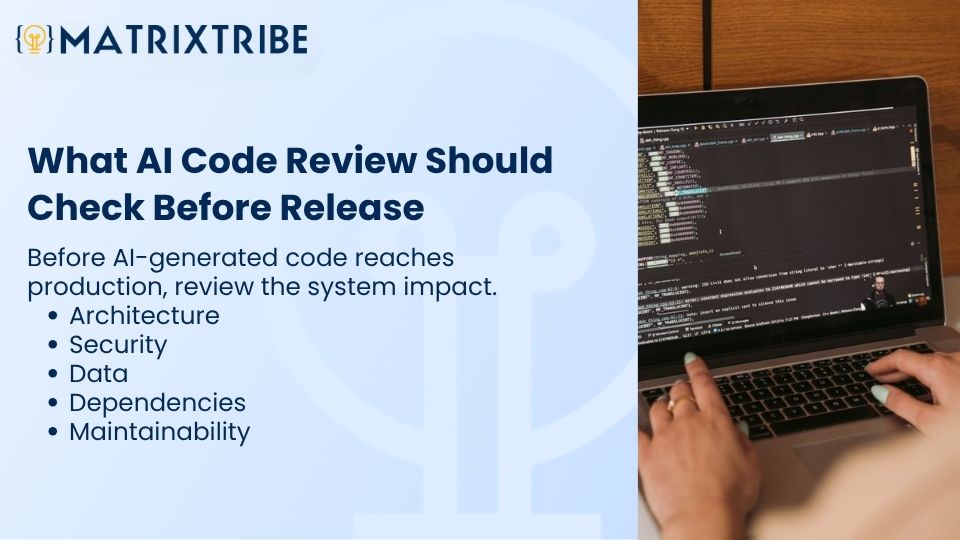
What AI Code Review Should Check Before Release
AI code review should validate more than functionality. A generated change should be checked for how it fits the system, what risks it introduces, and whether the team can safely maintain it after release.
Architecture Fit
The first check is whether the generated code belongs in the current architecture. A reviewer needs to look at whether the code follows existing patterns, respects service boundaries, and avoids duplicating logic that already exists elsewhere in the system.
If the code solves one task but weakens the overall structure, it should not move forward without revision.
Security Risk
AI-generated code can introduce weak access control, unsafe input handling, insecure defaults, or vulnerable patterns. The reviewer needs to check whether the code protects sensitive functionality, follows security standards, and avoids shortcuts that could create exposure in production.
This is especially important when generated code touches authentication, authorization, payments, customer data, or internal workflows. The Amazon Kiro incident showed how broad AI permissions can turn generated changes into production risk.
Data Impact
A reviewer needs to understand what data the generated code reads, writes, transforms, or exposes. This includes checking whether the code uses the right data source, follows approved access rules, and avoids creating undocumented data movement. If the data impact is unclear, the code is not ready for release.
Dependency Risk
AI-generated code may introduce packages, APIs, libraries, or external services without a clear reason. A review should confirm whether each dependency is necessary, secure, maintained, and approved for use. Any unnecessary dependencies increase attack surface, maintenance load, and licensing risk.
Maintainability
The final check is whether the team can support the code after it ships. The reviewer should ask whether the logic is clear, whether another engineer can debug it, and whether the code can be extended without creating more complexity.
AI-generated code should not only work today. It should remain understandable and reliable as the system grows.
How Review Strengthens the AI Governance Framework
Review strengthens an AI governance framework by turning understanding into a release decision. Once the team understands what the generated code does, Review determines whether that code is safe, suitable, and stable enough to move forward.
This matters because explaining generated code is not the same as approving it. A developer may understand how the logic works, but the team still needs to check whether it follows the right architecture, protects data, avoids risky dependencies, and can be maintained after release.
In the GRACE Framework, Review comes after Grasp and becomes the point where AI-generated output is either approved, revised, or rejected before it enters the system.
At MatrixTribe, we apply this approach inside AI-assisted development workflows. Generated code is reviewed for system fit, security, data impact, consistency, and maintainability before it reaches production.
Frequently Asked Questions
Q. What is AI-generated code review?
A. AI-generated code review is the process of checking AI-assisted output before it enters a software system. It evaluates whether the code works, fits the architecture, protects data, avoids risky dependencies, and can be maintained after release.
Q. Why is traditional code review not enough for AI-generated code?
A. Traditional code review assumes the developer understands the code they submitted. AI-generated code can include patterns, dependencies, or shortcuts the developer did not intentionally choose, so review must go beyond functionality and check system fit, security, and maintainability.
Q. What should teams review before approving AI-generated code?
A. Teams should review architecture fit, security risk, data impact, dependency risk, test coverage, maintainability, and ownership. The goal is to confirm that the generated code belongs in the system and can be safely supported after release.
Q. How does AI-generated code create software governance risk?
A. AI-generated code creates governance risk when it is accepted without enough context. It can introduce inconsistent patterns, unclear data flows, weak controls, hidden dependencies, and maintenance issues that become harder to trace once the code reaches production.
Conclusion
AI-assisted development can help teams move faster, but speed only creates value when the output can be trusted. That trust does not come from repeated AI code iterations. It comes from a structured review. Generated code must be checked for architecture fit, security risk, data impact, dependencies, and maintainability before it becomes part of the system.
This is why Review is the second principle in the GRACE Framework. It turns AI-generated output from something that works in isolation into something that has been validated for the system it will operate inside.
The teams that benefit most from AI-assisted development will not be the ones accepting the most generated code. They will be the ones that can review it with enough context, control, and responsibility before it reaches production.
Review AI-Generated Code Before It Becomes System Risk
At MatrixTribe, we help organizations build AI-assisted software with governance built into the development process. Through the GRACE Framework, our teams review generated code for system fit, security, data impact, consistency, and maintainability before it reaches production.
Contact us to build AI-assisted software with speed, structure, and control.
Published

Latest Article
 July 27, 2026