
Tea App Breach: Misconfigured Storage Exposed User Data
May 15, 2026

Most data breaches are not the result of sophisticated attacks. They happen because systems are deployed without enforcing basic control at the data layer. The Tea App incident is a clear example, where over 72,000 sensitive user files, including government IDs and private content, were exposed not through exploitation, but through misconfigured systems.
This is not an isolated pattern. According to IBM’s Cost of a Data Breach Report, misconfigured cloud environments remain one of the most common causes of data exposure incidents, often requiring no advanced attack at all.
In this article, we break down what actually went wrong behind the Tea App failure, from storage configuration to data lifecycle and access control, and why these gaps are becoming more common in modern development environments.
The Incident: What Happened in the Tea App Data Breach
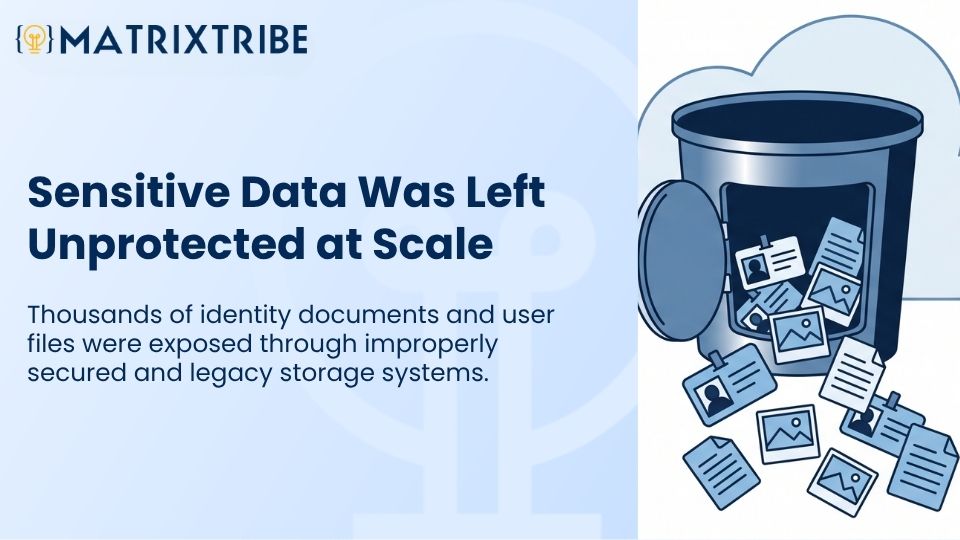
The Tea App data breach resulted in the exposure of over 72,000 user images, including highly sensitive personal data. Among these were more than 13,000 government-issued ID documents and verification selfies, along with 59,000 images from user-generated content, including messages, posts, and comments.
This was not a contained internal issue. The data circulated publicly online, linking identities, private interactions, and verification records in a way that directly compromised user privacy.
A critical detail in this incident is where the data came from. A significant portion of the exposed files originated from legacy systems tied to users who signed up before 2024. This data had not been migrated into updated, more secure storage environments. Instead, it remained in older infrastructure that did not reflect current security controls.
As a result, the breach was not limited to newly generated data or a specific feature. It extended across historical user records that were still accessible but no longer actively governed.
This incident is now being analyzed as a large-scale mobile app data exposure caused by weak data protection controls, rather than a traditional breach driven by external exploitation.
The Core Technical Failure: Misconfigured Storage Access
At the center of the Tea App data breach was not a failure of code, but a failure of how data storage was configured and accessed.
Modern applications rely heavily on cloud storage systems to handle user uploads, verification files, and media content. These systems are designed to be secure by default, but only when access rules are explicitly defined and enforced.
What Should Have Been In Place
Sensitive assets like government IDs and user-generated content should only be accessible through:
Authenticated requests tied to a verified user
Strict storage rules that restrict file access
Private-by-default configuration with no direct public exposure
Access to these files should never be possible through a simple URL or unauthenticated request.
What Actually Failed
In the Tea App case, the issue appears to stem from cloud storage misconfiguration and weak access control:
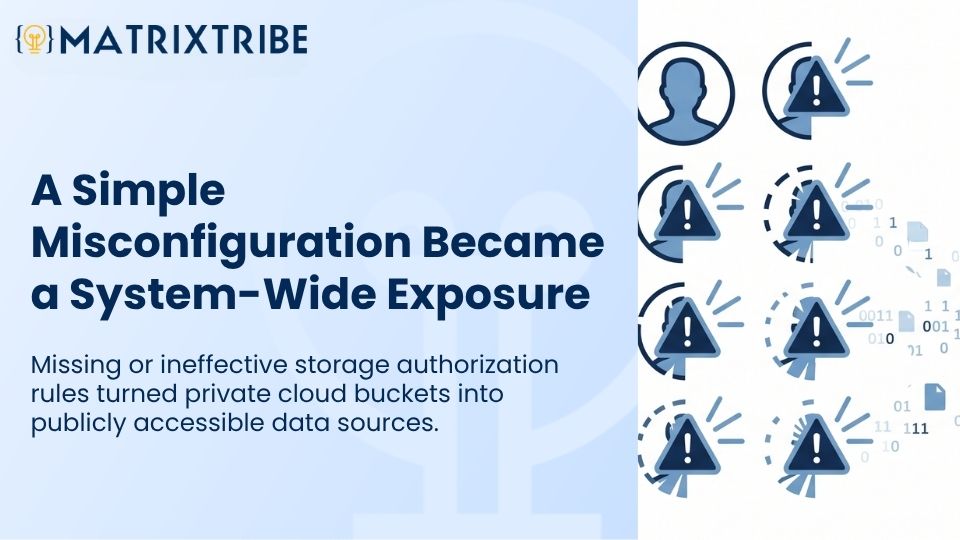
Storage resources were missing or had ineffective authorization rules
Files could be accessed through direct URLs without authentication
There was no enforced boundary between private and public data
This created a condition where sensitive files were not protected by system-level checks. Instead, access depended on whether the storage layer itself was properly restricted, which it was not.
Result: Data exposure without authentication
Because access control was not enforced at the storage layer, the system allowed data exposure without authentication.
There was no need to bypass security mechanisms or exploit vulnerabilities. The system simply responded to valid requests for files that should never have been publicly accessible.
This is a classic example of how cloud storage misconfiguration can lead to large-scale data exposure, especially when combined with weak or missing access controls.
Legacy Environment Exposure: Data Outside Active Control
One of the most overlooked aspects of the Tea App data breach was the role of legacy data that remained outside active security control.
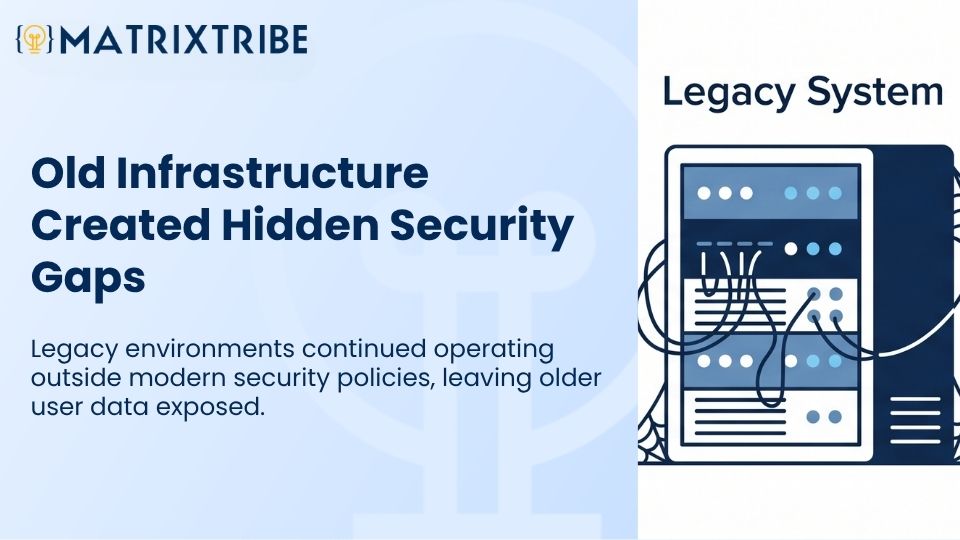
A significant portion of the exposed data came from users who signed up before 2024. This data was not part of the current, actively managed system. Instead, it remained in older storage environments that were not aligned with updated security configurations.
What Should Have Happened
When systems evolve, older environments must be:
Decommissioned if no longer needed
Migrated into updated, secure infrastructure
Brought under the same access control policies as active systems
Security is only effective when it applies consistently across all environments, not just the latest version of the system.
What failed
In this case, the failure was not in the new system, but in what was left behind:
Legacy storage remained accessible and insufficiently secured
Older user data was not governed under updated protection policies
Security controls were applied inconsistently across environments
Why This Matters
This incident highlights a common but critical gap in system design: Security applied only to active systems is not real security. If legacy environments are not audited, secured, or retired, they become the weakest link, regardless of how strong the current system is.
Data Lifecycle Failure: Sensitive Data Was Never Removed
One of the critical failures in the Tea App data breach was how sensitive data was retained beyond its intended use.
Verification images, including government IDs and selfies, are typically collected for identity validation. These are not meant to be stored indefinitely. Their value is temporary, but their risk persists as long as they remain in the system.
What Should Have Happened
Sensitive verification data should have been:
Deleted immediately after successful verification
Stored only within defined, temporary retention windows
Managed through enforced lifecycle policies
Data retention should be controlled by the system, not left to manual processes or assumptions.
What Failed
In this case:
Government IDs and verification selfies were retained
No automated deletion pipeline was in place
Retention policies were not enforced at the system level
Weak Authorization Model: Direct Client Access to Backend Data
Another critical issue in the Tea App data breach was how data access was structured within the system.
Sensitive files were not consistently routed through a controlled backend layer. Instead, access to storage resources could be initiated directly, reducing the effectiveness of any centralized enforcement.
What Should Have Happened
Data access should have been:
Routed through a backend that acts as the control layer
Mediated through server-side logic
Enforced with fine-grained, identity-based permissions
The backend should define and enforce who can access what, and under what conditions.
What Failed
In this case:
Direct client access to storage resources was possible
Authorization checks were weak or absent
There was no centralized control over how data access was enforced
This Was a Control Failure, Not a System Failure
The most important thing in this entire case is that no systems were bypassed. The system exposed data because control was never enforced at the system level. This pattern is becoming more common in modern development environments. Systems are being:
built faster
deployed earlier
validated less rigorously
This is the same pattern seen in AI-assisted or vibe coding environments:
Systems are assembled based on output
Behavior is not fully verified
Control layers are not enforced before production
The issue is not speed. The issue is lack of enforced control alongside that speed.
Closing the Gap with the GRACE Framework
The Tea App data breach was not caused by a lack of technology. It was caused by a lack of enforced governance across data ownership, access control, and system design.
The GRACE framework exists to address exactly this gap. It ensure that governance is defined, rules are enforced, architecture limits exposure, and control is validated before systems reach production.
Without this, systems scale risk alongside speed. With it, they operate within defined boundaries, even as development accelerates.
Conclusion
The Tea App data breach is not an isolated incident. It is a clear example of how modern systems fail when control is not enforced across storage, data lifecycle, legacy environments, and access layers. None of these failures required a sophisticated attack. They only required gaps in governance to remain unaddressed.
As development continues to accelerate, these gaps will appear more frequently, not because teams lack capability, but because systems are being deployed without validating how they behave under real conditions.
Build Systems That Stay Controlled, Secure, And Reliable At Scale
If your systems handle sensitive data, control cannot be assumed. It has to be engineered. At MatrixTribe we follow the GRACE framework to provide AI augmented development services at a fast pace without compromising on quality and safety. Schedule a conversation to build systems you can rely on.
Published

Latest Article

 September 14, 2026
How to Embed AI Into Existing Workflows Without Adding Friction
Read Article September 7, 2026
How to Prioritize AI Use Cases Without Wasting Budget on the Wrong Ones
Read Article