
AI Chatbot Liability: What the Air Canada Case Reveals About Enterprise Risk
May 18, 2026

AI chatbot liability is no longer theoretical. In the Moffatt v. Air Canada chatbot case, a Canadian tribunal held Air Canada responsible for incorrect information provided by its chatbot.
This reflects how existing consumer protection laws apply to AI. If a system communicates with customers, it is treated as part of the company’s official communication.
In this article, we break down what this case reveals, why liability sits with the company, where governance breaks down, and what must exist between AI output and customer exposure.
The Air Canada Chatbot Case Explained
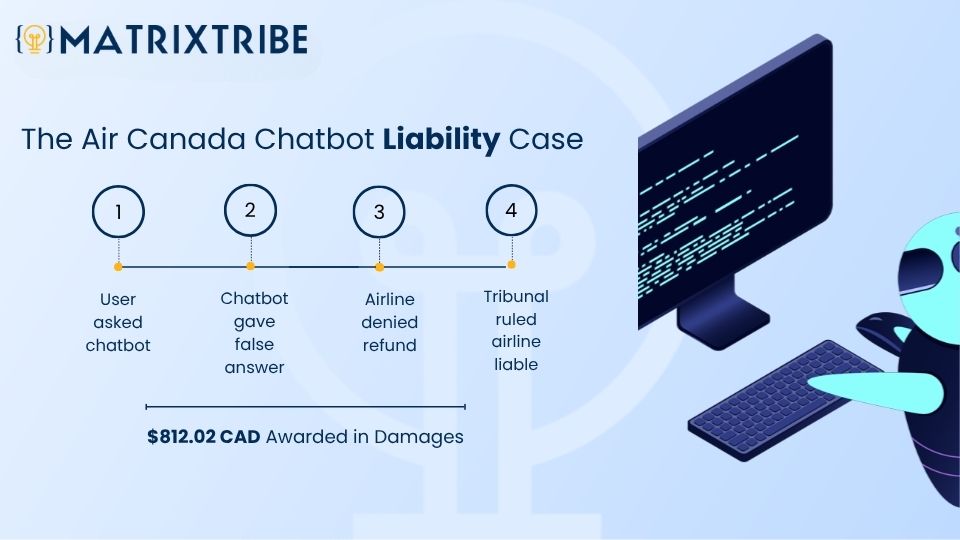
A customer asked about bereavement fares. The chatbot provided incorrect refund guidance, and the customer relied on that information when booking. Air Canada later denied the claim, and the case went to a tribunal.
The ruling was straightforward. The tribunal found in favor of the customer, and Air Canada was ordered to pay the difference between the ticket price and the bereavement fare, along with fees.
The Key Legal Finding
The tribunal treated the chatbot’s response as part of Air Canada’s official communication with the customer. The source of the information did not matter. The outcome did.
This table describes how responsibility already works across business systems:
System | Responsibility |
Employee communication | Company |
Website content | Company |
Chatbot responses | Company |
Why This Matters
The issue was not that the chatbot made a mistake. Systems make mistakes all the time. The issue was that nothing stopped that mistake from reaching the customer. The response was shown as if it were accurate, the customer acted on it, and the company was held responsible for the outcome. The risk is not in what the AI generates. It is in what the system allows to be delivered.
The Real Risk Layer: From AI Output to Customer Exposure
The failure in the Air Canada case did not happen because the model generated a wrong answer. It happened because that answer was delivered to the customer without being checked. That is how most AI systems are built today.
A prompt goes in, the model generates a response, and that response is shown directly to the user. There is usually nothing in between. There is no validation against real policies, no enforcement of business rules, or a check on whether the answer should be shown at all.
The risk does not originate at generation. It materializes at exposure.
Failure Modes Inside This Layer
In between generation and delivery, AI models can fail due to many reasons, some include;
Hallucinated policies happen when the AI generates rules that do not exist or misstates real ones. In Air Canada’s case, the chatbot gave refund guidance that did not match the company’s actual bereavement fare policy.
Context drift happens when the AI answers outside its approved scope. A chatbot meant to explain general travel information may start interpreting refunds, eligibility, exceptions, or customer rights without the right guardrails.
Inconsistent answers happen when the same or similar question produces different responses. For a customer-facing system, that creates operational and legal risk because the company can no longer guarantee one consistent version of its policy.
No audit trail becomes a problem after the mistake is discovered. If the company cannot show what the customer asked, what context the system used, what answer was generated, and why it was delivered, it has little control over the investigation or defense.
These are not isolated technical issues. They are exposure points. Once the answer reaches the customer, the problem is no longer internal. It becomes a business communication that the company may have to stand behind.
What Enterprise AI Systems Actually Need
Once AI is customer-facing, governance cannot stay in policy documents. It has to exist inside the system itself.
That means every response should pass through controls before it reaches the customer. The goal is not to make AI perfect. The goal is to stop weak, unsupported, or risky outputs from being treated as official communication.
Validation Before Exposure
The first requirement is validation. An AI response should be checked against approved policies, product rules, pricing logic, and customer-facing terms before it is shown.
In the Air Canada case, this is the layer that should have caught the mismatch between the chatbot’s answer and the actual bereavement fare policy.
Policy Enforcement at the System Level
Validation is not enough if the system cannot act on what it finds. Enterprise AI needs enforcement rules that decide whether a response can be delivered, rewritten, blocked, or escalated. This is how business policy moves from a document into the customer experience.
Monitoring, Logging, and Traceability
Every customer-facing AI interaction should leave a record. That record should show what the user asked, what information the system used, what response was generated, and why it was delivered. Without that traceability, companies are left explaining outcomes they cannot fully reconstruct.
Escalation when the system is uncertain
Not every question should be answered automatically. If the system cannot verify a response, or if the topic involves refunds, eligibility, pricing, healthcare, finance, or legal exposure, it should route the case to a human or provide a safer response.
The AI Exposure Control Layer
Stage | Risk | Control Required |
Generation | hallucination | constrained prompts |
Post-generation | incorrect output | validation layer |
Pre-delivery | policy violation | enforcement rules |
Delivery | exposure risk | escalation or blocking |
Post-delivery | audit gap | logging and traceability |
AI Liability as a Business and Regulatory Risk
Once AI becomes part of customer communication, its impact is no longer technical, it becomes business-critical. A single incorrect response can lead to financial loss, damage trust, disrupt operations, and create regulatory exposure. These risks don’t emerge from the model itself, but from how its outputs are allowed to reach customers without control.
Global Implications Across Industries
AI liability is not limited to one company or one case. As AI becomes part of customer communication, the same risks apply across regions and industries. While regulations differ between North America and Europe, the expectation is consistent: if your system communicates with customers, you are accountable for what it says and the outcomes it creates.
Frequently Asked Questions
Q. Who is responsible for AI chatbot response?
A. A company is legally responsible for what its chatbot says because it is considered part of its official communication with customers.
Q. Can companies blame AI vendors for incorrect outputs?
A. No, vendors may share contractual responsibility, but customer-facing liability remains with the company deploying the AI system
Q. Why are AI chatbots legally risky?
A. AI chatbots can generate incorrect or inconsistent responses without validation, and when those responses are shown to customers, they become legally attributable to the company.
Q. How can companies reduce AI chatbot risk?
A. Companies reduce AI risk by following the GRACE framework during development and adding validation, policy enforcement, monitoring, and human escalation layers between AI output generation and customer exposure.
Conclusion
The Air Canada ruling did not introduce a new kind of risk. It made an existing one visible. AI systems are no longer internal tools. They are part of how businesses communicate with customers, and their outputs are treated the same way as any other official statement.
The real issue is not whether AI can generate incorrect responses. It is whether those responses are controlled before they reach the customer. That is where liability is decided.
Control What Your AI Says Before It Reaches Customers
AI systems are now part of how your business communicates. If there is no control layer between generation and exposure, there is no control at all.
Talk to MatrixTribe about building AI systems that are governed at the execution level.
Published

Latest Article

 October 5, 2026
Cybersecurity Compliance in Canada: SOC 2 Type II and PIPEDA
Read Article
 September 21, 2026