
AI-Native Governance Principles for Software Development
June 2, 2026

AI can now help developers write code 55.8% faster, according to a controlled GitHub Copilot study. That speed is useful, but it also raises a harder question: can your team still control what enters production?
AI-assisted development is no longer just a productivity tool. It now influences how teams generate code, write tests, debug issues, refactor systems, and document software. The risk emerges when developers use AI without clear ownership, review standards, data boundaries, and traceability. This is where AI-native governance becomes necessary.
What Is AI-Native Governance?
AI-native governance is the practice of building ownership, review, access control, traceability, and workflow discipline into AI-assisted software development before AI-generated code reaches production.
It shifts governance from an after-the-fact review activity to an embedded part of the development lifecycle. The goal is to make AI-assisted output accountable before it becomes system behavior.
Principle 1: AI Generates, Humans Own
It is important to understand that AI can generate code, but a human has to own the outcome. AI can help developers write code faster, but it cannot take responsibility for what that code does in production. AI can assist with implementation, but an engineer still owns the decisions that shape the system, including architecture, reliability, security, and long-term maintainability.
Every AI-generated output should have a named human owner. That person should be able to explain what was accepted, why it fits the system, how it was validated, and how it can be fixed if something breaks.
If no one owns the output, no one owns the risk.
Principle 2: Guardrails Before Generation
Governance cannot start after AI-generated code is already written. By that point, the tool may have already used sensitive context, created unsafe logic, or introduced patterns that do not fit the system.
Traditional software governance often follows this path:
Build → Deploy → Govern
AI-assisted development needs a different flow:
Govern → Generate → Review → Deploy
This means teams should define approved AI tools, prompt standards, data boundaries, and review expectations before AI touches the project. Developers should know what information can be shared with AI, what the tool is allowed to generate, and which outputs require deeper review.
You cannot retrofit governance after AI-generated output is already in production.
Principle 3: Structured Review, Not Surface Checks
AI-generated code needs more than a quick check to see if it runs. A feature can work in a local test and still create problems inside the larger system.
Traditional code review assumes the developer intentionally wrote the change and understands the reasoning behind it. AI-assisted development changes that assumption. Generated code may include dependencies or shortcuts the developer did not fully intend.
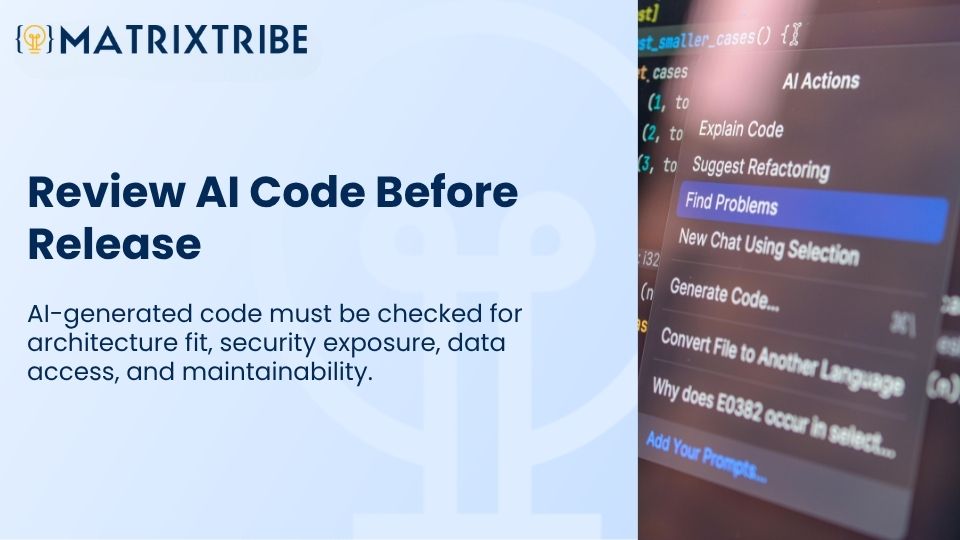
That is why review has to go deeper. Teams should check whether the output fits the architecture, duplicates existing logic, exposes data, weakens security, adds hidden dependencies, or creates maintainability issues. Unchecked AI output introduces invisible system-level risk.
Principle 4: Full Traceability and Visibility
If you cannot trace AI-assisted work, you cannot govern it. The team should know where AI was used, what it influenced, and how the final output was approved. That means tracking the tool used, the prompt or prompt category, the data provided to the tool, the code changed, the reviewer, and the tests or security checks that passed before release.
This visibility matters after deployment. When an incident happens, teams should not have to guess whether AI was involved or who approved the change. Traceability supports incident response, audits, customer security reviews, and compliance. It turns AI-assisted development from a hidden activity into a controlled engineering process. Visibility determines whether incidents are manageable or chaotic.
How MatrixTribe Helps Operationalize AI-Native Governance
AI-native governance only works when it becomes visible inside the engineering workflow. At MatrixTribe, we help organizations assess where AI is already being used, where governance is weak, and what controls are needed before AI-assisted output reaches production.
Furthermore, MatrixTribe also applies the GRACE Framework inside its own development workflows. This means our AI-assisted development services are governed by the same principles we help clients implement.
Frequently Asked Questions
Q. Which principle specifically focuses on helping users understand an AI system’s decision-making process?
A. Explainability. This principle focuses on making AI system behavior understandable by showing how outputs are produced, what factors influenced them, and whether the decision can be reviewed or challenged.
Q. What is the number one reason AI governance efforts quietly stall inside an organization?
A. The most common reason is lack of clear ownership. AI governance stalls when no team is accountable for decisions, controls, review processes, and ongoing risk management.
Q. What is the role of the AI ethics focal point in the review process?
A. The AI ethics focal point helps review AI use cases for ethical, legal, and operational risks. They guide teams on fairness, transparency, accountability, privacy, and responsible deployment before the system moves forward.
Q. Which principle involves assessing whether an AI model treats individuals or groups differently in ways that could lead to unequal outcomes?
A. Fairness. This principle examines whether an AI model creates biased or unequal outcomes across individuals or groups, especially based on sensitive attributes such as gender, race, age, location, disability, or socioeconomic status.
Q. What makes AI factsheets valuable in supporting trustworthy AI?
A. AI factsheets document key information about an AI system, including purpose, performance, safety, security, limitations, and provenance. This supports transparency, accountability, and informed review before adoption or deployment.
Conclusion
AI assistance is a huge part of how software teams build, test, review, and deliver systems. The advantage is speed, but speed only creates value when teams can still control the output.
AI-native governance gives organizations a way to use AI without weakening engineering discipline. It keeps ownership, review, access control, consistency, and traceability inside the development workflow, where they can actually prevent risk.
The teams that benefit most from AI will not be the ones generating the most code. They will be the ones that can govern AI-assisted development before it reaches production.
Build Faster Without Losing Control
At MatrixTribe, we help organizations turn AI-assisted development into governed engineering workflows. With the GRACE Framework, we help teams define ownership, review standards, access controls, consistency rules, and traceability before AI-generated code reaches production.
Contact us to build AI-assisted software with governance, control, and production discipline
Published

Latest Article

 October 12, 2026
How to Build an AI-Ready Data Pipeline: Quality, Freshness, Ownership, and Governance
Read Article October 5, 2026
Cybersecurity Compliance in Canada: SOC 2 Type II and PIPEDA
Read Article