
Vibe Coding Governance: Hidden Risks Breaking AI Development at Scale
May 15, 2026 / MatrixTribe

AI-assisted software development is increasing speed, but also introducing new risks. Development teams are shipping faster, yet losing visibility into what is actually being built and deployed.
An empirical research deduced that AI-assisted development increases productivity by 31.4% but introduces 23.7% more security vulnerabilities. Thus, highlighting a growing gap between speed and control. Governance has not scaled with this shift.
This has created a new class of system-level risks that are fast-moving, difficult to trace, and hard to control once deployed. In this article, we break down the critical risks emerging from AI-generated development and why governance must move from principles to system-level enforcement.
What Is Vibe Coding
Vibe coding refers to AI-assisted, prompt-driven software development where code is generated rapidly with minimal human ownership of the underlying logic.
Characteristics of vibe coding:
High-velocity, prompt-based generation: Code is produced in large volumes with minimal friction, reducing the time between idea and deployment.
Iterative, non-deterministic outputs: The same prompt can produce different results across iterations, making behavior less predictable.
Limited traceability between input and system behavior: There is often no clear mapping between what was asked, what was generated, and how the system behaves in production.
These characteristics introduce a structural challenge for governance.
Traditional software development assumes that engineers understand the logic they write, can explain how systems behave, and can trace issues back to specific changes. Vibe coding breaks this chain of assumption.
AI Development Risks in Modern Software Systems
AI-assisted development is changing more than the speed of software delivery. It is changing how systems evolve, how decisions are made, and how risk accumulates over time.
Unlike traditional software risks, which are often tied to identifiable bugs or design flaws, AI-driven development introduces risks that are less visible and more systemic. These risks do not appear immediately. They build gradually as systems scale, making them harder to detect and even harder to control. Here are four major risks of vibe coding for enterprise systems.
Hidden Technical Debt in AI-Generated Systems
One of the earliest and most persistent risks is the accumulation of technical debt. AI-generated code is often accepted because it works in isolation. However, each iteration introduces variation in structure and logic. Over time, these inconsistencies begin to conflict, especially as multiple developers interact with generated outputs.
This typically shows up as:
Inconsistent patterns across the codebase
Fragmented architecture with no unifying structure
Increasing integration and maintenance complexity
The issue is not that teams are making poor decisions. It is that the system is evolving without consistent oversight. At scale, this results in systems that grow faster than they stabilize.
Code Without Comprehension
As reliance on AI-generated code increases, understanding of the system decreases. Developers can generate, test, and deploy code without fully understanding how it works. While this might not surface during development, but becomes critical when systems need to be debugged, modified, or scaled.
Over time, this leads to:
Inability to clearly explain system logic
Slower and less reliable incident response
Increasing difficulty in modifying or extending systems
This creates a fundamental governance challenge. Controls and safeguards depend on clarity and traceability. Without a clear understanding of system behavior, governance cannot be reliably enforced.
Security and Compliance Exposure
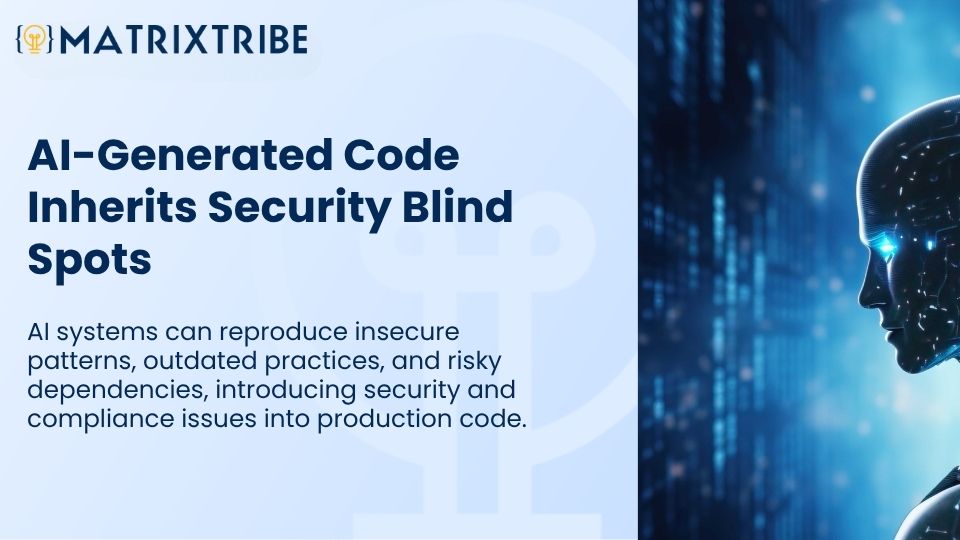
AI-generated code introduces security and compliance risks that are often underestimated. Most AI models are trained on large datasets that include publicly available code. As a result, they can reproduce insecure patterns, outdated practices, and dependencies with known vulnerabilities or licensing constraints.
In practice, this shows up as:
Reuse of insecure or outdated code patterns
Introduction of vulnerable dependencies
Exposure to licensing conflicts in proprietary systems
These risks are not theoretical anymore. They are highlighted by incidents such as the Tea app breach, where misconfigured storage exposed sensitive user data. And cases like the Lovable app, where missing access controls led to production data exposure, highlight a recurring pattern. In both cases, the systems functioned as intended, but critical governance checks were missing.
These examples reflect a broader issue. As development speed increases, security validation often lags behind. Vulnerabilities are not always introduced deliberately. They emerge as a byproduct of rapid, ungoverned code generation.
Deployment Instability and Operational Risk
The final layer of risk becomes visible in production. AI-generated changes can have a wide impact, even when they originate from a small prompt. A single input can affect multiple parts of a system without clear boundaries or predictable outcomes.
In practice, this leads to:
Changes propagating across interconnected services
Monitoring becoming reactive instead of proactive
Slower debugging due to unclear change origins
Complex and risky rollbacks due to hidden dependencies
This pattern is already evident in real-world infrastructure failures. Incidents involving platforms like Amazon Web Services have shown how small configuration changes can cascade into large-scale outages. As AI becomes more involved in generating and modifying code, the likelihood of such cascading effects increases.
At this stage, the challenge is no longer limited to code quality. It becomes an issue of operational control, where maintaining system reliability requires visibility that many teams no longer have.
What Vibe Coding Governance Requires (GRACE Framework)
Vibe coding does not fail because of bad tools. It fails because governance has not adapted to how software is now being created.
Traditional development assumes that code is written, reviewed, and understood by humans. Governance is built around that assumption. In AI-assisted development, that assumption no longer holds.
This requires a shift. Instead of focusing on code review after generation, governance needs to validate how systems behave. Instead of relying on static policies, controls need to be enforced continuously as code is generated and deployed. And instead of holding individual developers accountable, accountability needs to exist at the system level.
This is where structured governance becomes necessary.
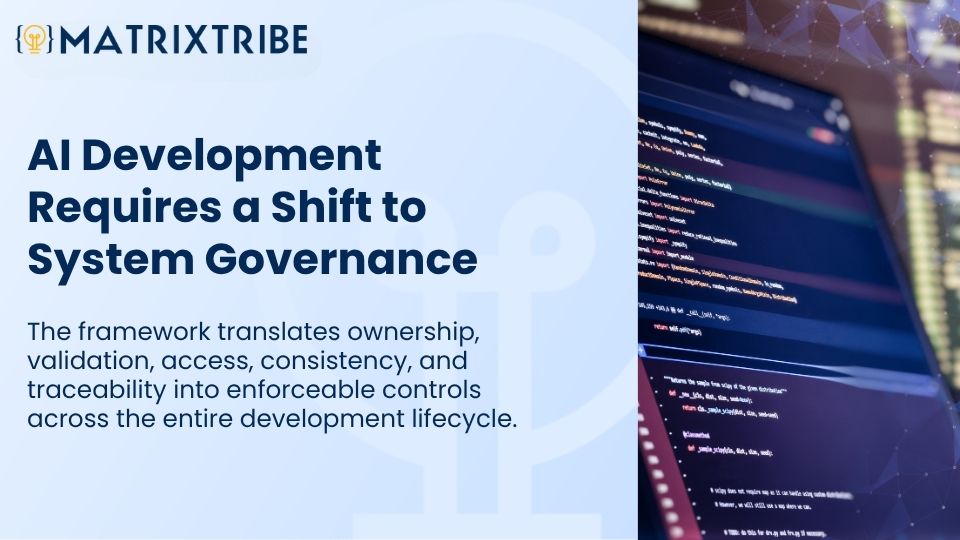
The GRACE Framework translates these shifts into something operational. It defines how ownership, validation, access, consistency, and traceability are enforced across the development lifecycle.
Frequently Asked Questions
Q. What are the risks of AI-generated code in software development?
A. AI-generated code introduces risks such as hidden technical debt, lack of comprehension, security vulnerabilities, and deployment instability. These risks arise because code is produced faster than it can be fully reviewed, validated, or understood.
Q. Why is AI-assisted coding risky in production systems?
A. AI-assisted coding is risky because outputs are not always fully understood, traceable, or consistently validated. This makes it difficult to enforce governance and maintain control over system behavior in production.
Q. What is vibe coding in software development?
A. Vibe coding is AI-assisted, prompt-driven code generation where systems are built rapidly with minimal human ownership of the underlying logic, leading to reduced traceability and control.
Q. Who is responsible for AI-generated outputs?
A. Organizations deploying AI systems remain fully responsible for their outputs, including any errors, security issues, or unintended system behavior.
Conclusion
AI is not the risk but uncontrolled AI based development is. Vibe coding increases speed, but reduces visibility into how systems are built and behave. As systems scale, this gap leads to instability, security exposure, and loss of control.
Cases like lovable app data breach and tea app failure are not isolated issues. They are the result of governance not keeping up with how software is now created. The solution is in proactive governance frameworks like GRACE.
Regain Control Over AI-Driven Software Development Before It Scales
At MatrixTribe we combine rapid AI-driven development with system-level governance, ensuring your software scales without introducing hidden risk. Contact us to build AI-driven systems with the control needed to scale safely.
Published

Latest Article
 July 7, 2026
Explainable AI in Software Development: Why Every Output Needs a Trail
Read Article July 1, 2026
Consistency in AI Governance: Why AI‑Assisted Development Needs Shared Standards
Read Article June 23, 2026