Claude Chats in Google Search: An AI Security Lesson
August 4, 2026
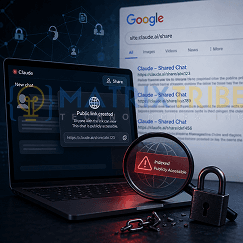
Some Claude conversations appeared in Google and Bing because users had created public sharing links that search engines could discover. The incident did not expose every private Claude account. However, it demonstrated how unclear sharing controls, missing indexing protections, and sensitive AI outputs can combine to create a serious business security risk.
Anthropic describes shared chats as publicly accessible snapshots, while reporting found that some shared pages lacked a noindex directive. Google’s own documentation states that robots.txt is not a reliable mechanism for keeping a webpage out of search results.
The problem was not simply that people shared AI chats. It was that a convenience feature effectively became a publishing channel without users fully understanding the consequences.
What Happened to the Shared Claude Chats?
In July 2026, publicly shared Claude conversations began appearing in Google and Bing search results. The reports caused concern because some of the indexed pages contained personal, professional, and potentially sensitive discussions. The affected pages were conversations that users had converted into publicly accessible sharing links.
How Claude’s Chat-Sharing Feature Works
Claude conversations are not automatically published online. A user has to select the Share option and confirm that they want to create a shareable link. Claude then generates a public URL containing a snapshot of the conversation. According to Anthropic’s official sharing documentation, the snapshot includes all messages sent before the chat was shared, including any artifacts.
Anyone with the public URL can view the shared snapshot without signing into the original user’s account. Messages added after the link is created remain private unless the user manually updates the shared version. Users can also disable the link by returning the conversation to private visibility.
How Search Engines Discovered the Public Links
A webpage can be publicly accessible without immediately appearing in Google or Bing. First, the sharing feature creates a page that anyone with the URL can open. A search engine must then discover that URL, usually because it has been linked or posted somewhere accessible to its crawlers. After discovery, the search engine may add the page to its index and display it when someone enters a relevant search query.
Axios reported that Anthropic clarified it does not provide directories or sitemaps of shared chats to search engines. This means Google and Bing were not necessarily given an official list of Claude conversations. However, a public URL can still be discovered when users post or link to it elsewhere on the web.
WIRED reported that Anthropic’s robots.txt file had restricted crawlers from accessing shared Claude chats since at least September 2025. However, WIRED’s review of a sample of the affected pages found that they did not contain a separate noindex instruction. WIRED also states that Anthropic did not respond to its requests for comment about the missing tag.
The difference matters because robots.txt primarily controls whether a crawler can request a page. It does not reliably prevent the URL from appearing in search results. Google’s official documentation explains that a URL blocked through robots.txt can still be indexed when other websites link to it.
A noindex directive serves a different purpose. It tells supporting search engines not to include the page in their results. However, Google must be able to crawl the page to detect that instruction. Google therefore advises site owners not to rely on robots.txt to prevent indexing and explains how to implement noindex.
Were All Private Claude Conversations Exposed?
There is no evidence that Google, Bing, or members of the public accessed ordinary private conversations inside Claude accounts. The reported pages came from chats that users had actively converted into public sharing links. Search engines indexed some of those public URLs. The incident therefore did not involve the mass exposure of every Claude conversation or unauthorized entry into user accounts.
A conversation that users expected to circulate within a small group could become visible to people searching the wider web. That distinction, between limited discoverability and actual privacy, is what turned an ordinary sharing feature into a much larger public concern.
Why This Incident Matters Beyond Claude
The Claude incident reflects a wider business risk. AI conversations increasingly contain information drawn from software development, internal operations, customer work, legal reviews, financial analysis, security investigations, and employee communication. When that happens, a chat is no longer just an informal exchange. It can become part of the organization’s operational record.
AI Conversations Now Contain Operational Business Data
AI assistants are becoming connected to the systems where companies conduct their work. Claude, for example, can access selected GitHub repositories, search and retrieve information through Google Workspace connectors, and search across SharePoint, OneDrive, Outlook, and Teams.
As a result, a single conversation may contain source code, infrastructure details, customer information, contract terms, financial assumptions, product plans, security findings, or employee data. Sharing that conversation can therefore expose business information belonging to the organization, its customers, or its employees.
Connected AI Tools Can Increase the Sensitivity of Outputs
Information passes through several stages when an AI assistant uses a connected system. The original data remains inside the source application. The assistant retrieves the information needed for the task, uses it to produce a visible response, and may reproduce important details inside the conversation. If that chat is later shared, the visible response may become part of the shared snapshot.
According to Anthropic’s chat-sharing documentation, an attached file itself is not included when a conversation is shared, and raw information retrieved through MCP tool calls remains hidden. However, the conversation and Claude’s final responses are visible. This means sensitive information can still be exposed when Claude quotes, summarizes, explains, or otherwise reproduces it in the output.
A contract does not need to be downloadable if the response reveals its confidential terms. Similarly, a private repository does not need to be attached if the conversation reproduces sensitive code or security weaknesses from it.
Convenience Features Can Become Uncontrolled Publishing Channels
Users may interpret Share as a collaboration feature intended for a colleague or selected recipient. However, when sharing creates a public webpage, the technical outcome is closer to publishing. An unguessable URL may reduce accidental discovery, but it does not authenticate viewers or prevent the link from being forwarded, reposted, captured, or archived.
Anthropic allows users to change a shared chat back to private, which disables the original link. However, revoking that link cannot remove copies, screenshots, or information already saved elsewhere.
The broader product-design lesson is that the meaning presented to users must match the system’s actual behavior. When a feature creates publicly accessible content, it should not appear to offer the same protection as controlled, recipient-specific sharing.

How MatrixTribe Would Build a Safer AI Sharing Feature
At MatrixTribe, we would not treat AI conversation sharing as a simple front-end feature. Under the GRACE Framework, its security requirements would be defined before development begins and retained throughout AI-assisted design, coding, testing, review, and release.
Private and Controlled Sharing by Default
We would make authenticated, recipient-specific sharing the default. Users could grant access to named individuals, verified email addresses, project members, or authorized people within their organization. Public publication would remain a separate action with a clear warning that anyone with the URL may view, forward, copy, or archive the content.
Before publication, the interface would show exactly which prompts, responses, artifacts, and extracted information would become visible. It would also require the user to confirm that sensitive business, customer, employee, or security information had been removed.
Layered Security Controls
We would not rely on an unguessable URL or a noindex directive as the primary protection. Restricted conversations would require authentication, while public pages would use indexing controls only as an additional safeguard. Google recommends password protection when content must only be accessible to authorized users.
Depending on the system and its risk level, we would also introduce expiring links, immediate revocation, secret scanning, sensitive-data detection, data-loss prevention rules, and administrative restrictions on public publishing. These controls would be tested during development and again before release rather than added only after an exposure occurs.
Review, Approval, and Ongoing Visibility
Controls aligned with a SOC 2 Type 2 environment require more than a secure initial design. Changes to the sharing feature would pass through documented review, testing, approval, and deployment processes. Access permissions would follow least-privilege principles, while logs would record who created a link, what visibility setting was selected, when access changed, and who revoked it.
Administrators would receive a central inventory of active links, owners, creation dates, expiration dates, visibility settings, and risk alerts. This creates the evidence needed to investigate an incident, remove inappropriate access, and verify that the feature continues to operate as designed.
The difference is not that MatrixTribe would deliver the feature more slowly. The GRACE Framework allows teams to use AI for faster software delivery while keeping security review, controlled access, testing, approval, and traceability inside the delivery process.
What the Claude Incident Shows About Secure AI-Based Software Delivery
The Claude chat-indexing issue illustrates a wider risk in AI-driven software delivery: teams can build and release features faster, but speed can allow important security questions to be missed. A sharing feature may work exactly as designed while still creating exposure if public access, search indexing, privacy defaults, and user expectations are not examined during development and testing.
An AI Governance Framework helps prevent this by placing security, human review, controlled access, consistent development standards, and traceability inside the AI-assisted delivery process. The lesson is not simply that users should be careful when sharing chats. It is that teams developing AI products must ensure faster delivery does not move features into production before their security consequences are understood and tested.
Frequently Asked Questions
Can Claude Chats Appear in Google Search?
Yes. Publicly shared Claude chats can appear in search results if search engines discover and index their URLs. The reported incident involved conversations that users had converted into public share links. It did not involve Google accessing ordinary private chats inside Claude accounts.
Are Claude Conversations Public by Default?
No. Claude conversations are private by default. A user must deliberately select the sharing option to create a public snapshot. Anyone with that link can view the shared content.
Are Claude Chats Completely Private?
Not completely. Chats are not publicly visible by default, but Anthropic may process or retain them according to its privacy settings, safety policies, and legal obligations. Users can also allow selected chats to be used for model improvement.
Is Claude Chat Safe to Use?
Claude can be used safely for many tasks when appropriate access controls and data-handling rules are followed. However, no AI chat should be treated as a secure place for unrestricted sensitive information. Organizations should use managed business accounts, control connectors and sharing, review outputs, and avoid entering credentials or unnecessary confidential data.
Are Claude Chats Actually Deleted?
For consumer accounts, deleting a conversation removes it from chat history immediately and schedules deletion from Anthropic’s backend systems within 30 days. Exceptions may apply for legal, security, policy-enforcement, or dispute-resolution purposes. Data previously used in completed model-training runs cannot be removed from an already trained model. Review Anthropic’s retention policy.
Who Can See My Claude Chats?
Normally, you can see your own chats. Anyone with a public share link can view its snapshot. Limited Anthropic personnel may review certain consumer data under defined privacy or safety conditions. On Claude for Work, an organization’s Primary Owner can request exports that may include conversations, uploaded files, and usage data.
Conclusion
The Claude incident demonstrates that AI risk does not exist only inside prompts, models or training data. Risk also appears in the interfaces, configurations and sharing workflows surrounding the model. Organizations therefore need to govern what happens before, during and after an AI output is generated.
Build AI Agents Without Creating New Security Gaps
MatrixTribe builds custom AI agents with those controls included from the start. We combine AI-assisted delivery with secure system architecture, controlled access, human review, testing, monitoring, and clear audit trails.
Contact MatrixTribe to build AI agents that move your business forward without putting security, control, or accountability at risk.
Published

Latest Article

 September 14, 2026
How to Embed AI Into Existing Workflows Without Adding Friction
Read Article September 7, 2026
How to Prioritize AI Use Cases Without Wasting Budget on the Wrong Ones
Read Article