What SOC 2 Type II Actually Tells You About a Software Development Partner
September 21, 2026
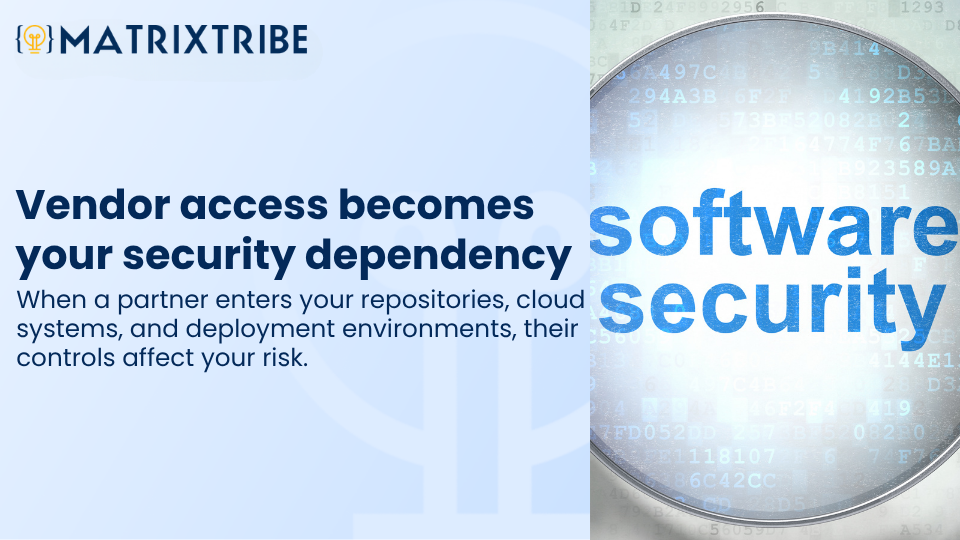
SOC 2 Type II gives you independent evidence that defined controls at a service organization were suitably designed and operated effectively over a specified period. Depending on the report’s scope, this may include controls related to access, software changes, vulnerabilities, security monitoring, and incident response.
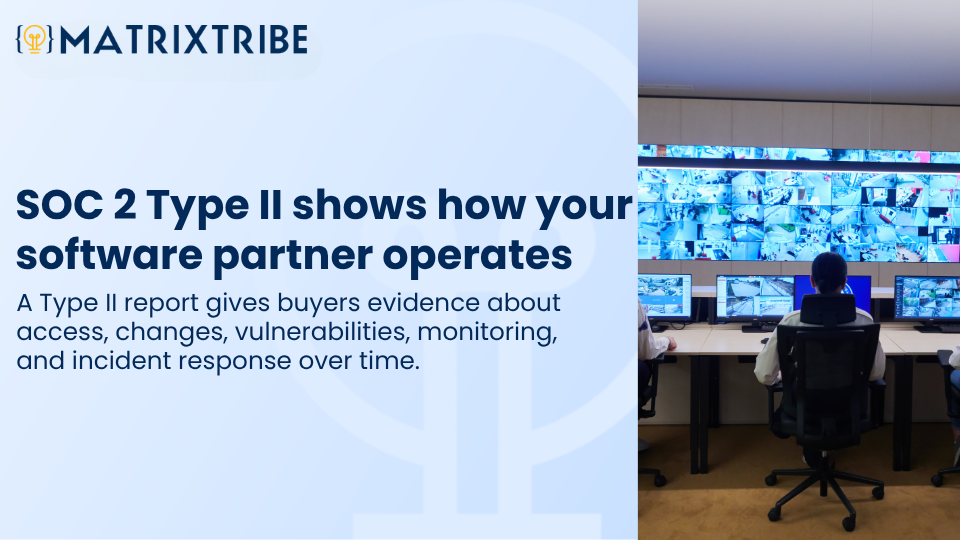
That evidence matters because a software development partner works inside your repositories, applications, cloud resources, infrastructure, APIs, deployment environments, and business systems. The partner’s security practices therefore become part of your own vendor-risk assessment. As the AICPA explains, SOC assurance reports provide information that helps users assess risks associated with outsourced services.
Why SOC 2 Matters When a Vendor Accesses Your Technology Environment
A software development partner can create a deeper security dependency than an ordinary supplier. Because its personnel can receive legitimate access to the systems where your software is built and operated.
That access may include source code, technical documentation, cloud consoles, project-management systems, credentials, staging environments, production resources, and internal applications. A weakness in how the partner authorizes access, protects accounts, manages devices, or supervises technical work can therefore affect your environment as well as its own.
The industry evidence supports taking this dependency seriously. Verizon’s 2025 Data Breach Investigations Report found that third-party involvement in breaches doubled from 15% to 30%. It shows why a vendor’s assurances should be supported by evidence. When a partner will operate inside your technology environment, a statement that it “takes security seriously” tells you very little. A SOC 2 Type II report gives you a structured way to examine whether relevant controls existed and operated during the period covered by the examination.
What SOC 2 Type II Can Tell You About Access Management
A SOC 2 Type II report can provide evidence that defined access-management controls operated during the audit period. Depending on scope, these may cover access approval, account provisioning, authentication, access reviews, privileged permissions, and removal of access when it is no longer required.
This matters because external developers usually receive valid credentials. The security question is how those credentials are governed before, during, and after the engagement. A valid credential can become an attack path if access is excessive, remains active too long, or is not monitored appropriately.
Sophos found that identity played a major role in ransomware incidents covered by its research. In The State of Ransomware 2026, 79% of the 2,158 ransomware attacks reported by surveyed organizations began with an identity-based approach, either by obtaining credentials or abusing credentials that had already been obtained.
A SOC 2 type II compliant organization lowers this risk by defined processes for authorizing users, applying authentication requirements, reviewing access, and removing permissions.
What It Can Tell You About How Software Changes Are Controlled
Change controls show you how a partner moves software from an assigned task to reviewed, tested, and authorized deployment. They complement access controls: access controls govern who may act, while change controls govern how a proposed change progresses through the delivery environment.
MatrixTribe’s current secure software development process provides a practical example. Authorized work begins with a tracked task and a feature or working branch. Changes progress through pull requests, independent review, required approvals, automated checks, development testing, staging testing, release authorization, and production verification.
The documented workflow also requires comments and tasks to be resolved before merge. CI/CD checks may include builds and tests, dependency scanning, secret detection, static analysis, linting, and deployment validation. Development and staging provide separate opportunities to verify the correct branch, version, commit, or artifact before a production release is approved.
Through SOC 2 a disciplined process is adapted that connects the original task to the code change, reviewer decision, test results, deployment approval, production version, and any rollback or recovery action.
What It Can Tell You About Ongoing Security Operations
Once development begins, security depends on how consistently a partner identifies weaknesses, monitors relevant activity, and responds when something requires attention. A SOC 2 Type II report can provide evidence that defined controls in these areas operated during the audit period.
Vulnerability Identification and Remediation
Vulnerability management explains how a partner handles security weaknesses throughout the systems and software lifecycle. A defined process should cover how vulnerabilities are identified, assessed, prioritized, assigned, remediated, and tracked to closure.
The findings can come from security scans, dependency checks, endpoint alerts, vendor advisories, code reviews, or cloud-service notifications. Their significance is clear in Verizon’s 2025 Data Breach Investigations Report, which found that exploitation of vulnerabilities as an initial access vector increased by 34% compared with the previous report.
SOC 2 Type II does not establish that vulnerabilities will never exist. However, it does provide reassurance that your software partner followed its defined process for identifying and addressing them during the period examined.
Security Monitoring and Incident Response
Monitoring provides the signals that allow a partner to recognize suspicious activity. When an event is identified as a potential incident, the response process should guide its assessment, containment, remediation, recovery, and subsequent review. This connection between monitoring and response matters because attackers may move quickly after gaining access. The CrowdStrike 2026 Global Threat Report found that the average observed eCrime breakout time fell to 29 minutes in 2025.
A documented policy describes what is supposed to happen. A Type II examination provides evidence about whether the controls not only exist but are operational across development environments for continuous monitoring.
What MatrixTribe’s SOC 2 Type II Means for Software Development Clients
The service auditor examined the description of the MatrixTribe system and evaluated the suitability of control design and operating effectiveness during a defined period.
The system described in the report reflects how we deliver technology services. Our personnel generally work in client-controlled repositories, cloud resources, applications, development environments, and, when authorized, production systems. The examined system therefore focuses on the governance, personnel, endpoints, internal services, policies, and procedures used to manage that access and deliver authorized work.
The report and supporting procedures address control areas relevant to software delivery:
Control area | Why it matters during software delivery |
Access management | Helps govern how access is approved, provisioned, reviewed, changed, and removed |
Change management | Supports traceable review, testing, authorization, and deployment |
Vulnerability management | Supports identification, assessment, prioritization, and remediation of weaknesses |
Security monitoring | Supports the review and escalation of relevant security events |
Incident response | Defines how suspected incidents are assessed, contained, remediated, and reviewed |
Vendor management | Supports oversight of third parties used in our operating environment |
MatrixTribe does not ask prospective clients to rely only on our description of our practices. Controls within the Security scope of our SOC 2 Type II examination were independently evaluated for design and operating effectiveness during the audit period. Our documented delivery workflow then translates those controls into day-to-day practices for application development, including repository access, pull requests, CI/CD checks, testing, approvals, staging, deployment, and evidence retention.
Conclusion
SOC 2 Type II should not make the vendor decision for you. It gives you stronger independent evidence for making that decision. When a development partner will access your technology environment, you need to understand who can enter it, which controls govern their actions, how changes are reviewed and deployed, and what happens when a security issue appears. A relevant Type II report helps you test those claims against an independent examination and a defined audit period.
If you need an accountable partner for full-cycle software delivery, explore MatrixTribe’s software development outsourcing services.
Published

Latest Article
 September 21, 2026
What SOC 2 Type II Actually Tells You About a Software Development Partner
Read Article September 14, 2026
How to Embed AI Into Existing Workflows Without Adding Friction
Read Article September 7, 2026