How SOC 2 Type II Strengthens Software and AI Delivery
September 28, 2026
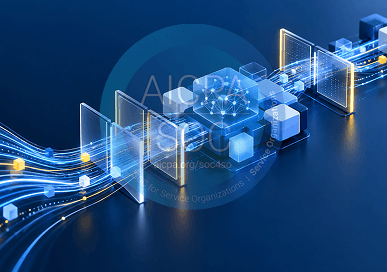
AI is making software delivery move faster. AI-assisted development, reusable components, APIs, automation, and modern CI/CD pipelines let teams build, test, and release in shorter cycles. For businesses, that can mean faster product development, quicker iteration, and less time between an idea and a working system.
The security challenge is that speed does not remove the controls needed around the work. Changes still need review, integrations still need governed access, dependencies still need scrutiny, and development activity still needs monitoring.
As software and AI systems become faster to build and more connected to business operations, the controls around development have to keep pace. This article looks at where that pressure shows up and how disciplined security practices help manage it.
Faster Delivery Means More Change to Govern
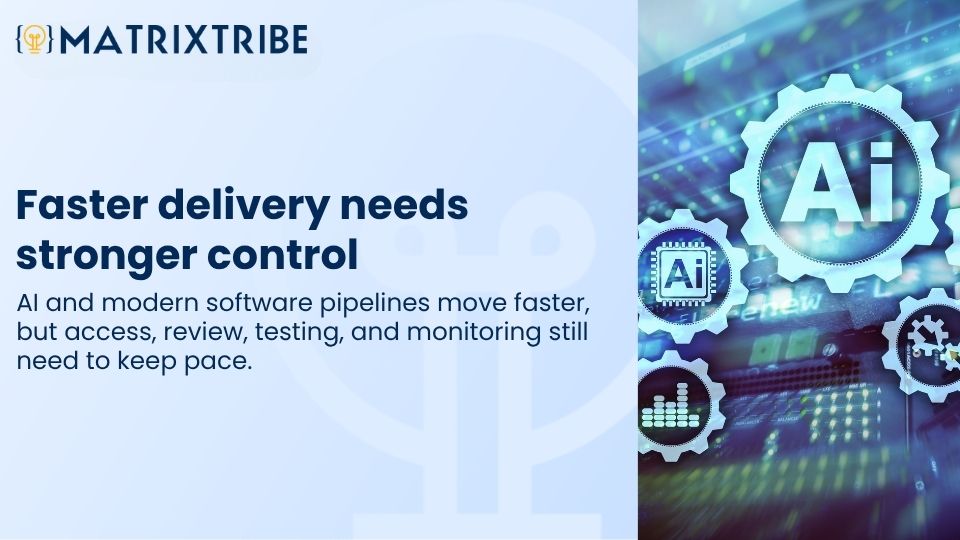
Faster delivery increases the number of changes moving through the development process at any given time. More commits are created, dependencies are updated more frequently, configurations change more often, deployments happen in shorter intervals, and AI-assisted development can add larger volumes of generated code to the review queue.
That creates a change-governance problem. Each individual change may be small, but the cumulative volume increases the chances of something moving forward without enough scrutiny. A dependency update can introduce a vulnerability. A configuration change can affect access or availability. Generated code can contain insecure logic or expose secrets if it is accepted too quickly.
Google’s DORA research found that a 25% increase in AI adoption was associated with a 3.1% increase in code review speed, but also a 7.2% reduction in software delivery stability. The finding reinforces a practical point: faster development does not reduce the need for review, testing, approvals, and controlled releases. It raises the standard those processes have to meet.
As change velocity increases, the controls around it become more important because they determine which changes are allowed to progress, what evidence is required before approval, and how safely software moves toward production.
AI Expands the Security Surface Beyond the Code
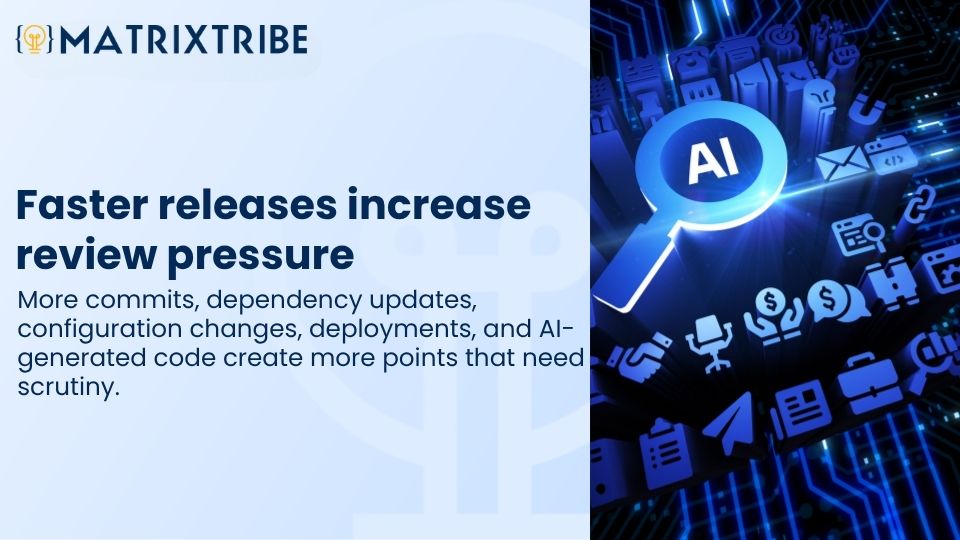
AI systems rarely operate in isolation. In enterprise environments, they connect to internal applications, APIs, databases, cloud platforms, business workflows, third-party services, and the credentials or secrets needed to access them. This is especially relevant for AI agents, which can move beyond generating responses to retrieving data, calling tools, and triggering actions across connected systems.
The larger exposure often sits in what the system can reach and what it is allowed to do. An AI workflow connected to a CRM, internal knowledge base, payment system, or cloud environment may be able to retrieve sensitive information, move data between systems, or initiate downstream actions. Each connection adds another point where permissions, credentials, tool access, and data handling have to be governed.
Microsoft’s 2026 research into its Semantic Kernel framework demonstrated how this risk can escalate. Researchers identified two critical vulnerabilities, since fixed, where prompt injection could cross into connected tools and, under specific configurations, lead to unauthorized host-level code execution. Microsoft’s analysis made the architectural lesson explicit: the AI model was not the security boundary. The risk emerged from how model-controlled inputs were trusted by the tools and functions surrounding it.
As AI becomes more deeply integrated into business operations, securing the model is only one part of the job. The integrations, identities, infrastructure, and capabilities around it determine much of the system’s real operational exposure.
Security Controls Have to Scale With Speed and Reach
As delivery accelerates and AI systems connect to more of the business environment, security has to operate throughout development. Access, code changes, automated checks, environments, vulnerabilities, and incidents all affect one another. Weakness in one layer can undermine the controls around the others.
Control Who Can Access What
Access governance starts with a simple question: who needs access, and to what? At MatrixTribe, repository access follows a defined request and approval process. Access is tied to project responsibilities rather than granted automatically when someone joins a project. As responsibilities change, access should change with them. This becomes more important when a project reaches beyond source code into infrastructure, applications, data, APIs, or AI-connected systems.
Control How Changes Move Forward
Once development begins, changes need a defined route into shared environments. Our development workflow uses feature or working branches, followed by pull requests and review before code can merge into Dev. Required approvals, completed checks, resolved comments and tasks, and the absence of outstanding change requests create clear gates before a change progresses. This keeps implementation and approval from becoming the same action.
Automate the Checks That Should Not Depend on Memory
Human review is necessary, but reviewers should not have to catch every repeatable technical issue manually. Our CI/CD requirements include build and testing checks, dependency scanning, secret detection, static analysis, linting, and deployment validation. These checks target different risks before code moves further through delivery.
Automation also makes those checks repeatable. The same requirements can run against every qualifying change rather than depending on whether someone remembers to perform them.
Separate Development From Release Environments
Changes should move through controlled environments rather than jump directly toward production. MatrixTribe's workflow moves code through Dev and Staging, with deployment and testing before it progresses. Each stage creates another point to identify problems before they reach a higher-impact environment.
The boundaries matter because they limit how far an incomplete, faulty, or insecure change can travel without validation.
Track Vulnerabilities Through Remediation
Approval and deployment do not close the security process. Vulnerabilities may emerge in application code, dependencies, infrastructure, or supporting components after development has moved forward.
Vulnerability management needs to identify the issue, assess its significance, assign remediation, and track it to resolution. This gives discovered weaknesses an accountable path instead of leaving remediation to informal follow-up.
Define What Happens When a Security Event Occurs
Some issues will only become visible through monitoring or during operation. Teams therefore need a defined path for evaluating security events, escalating them, containing their impact, and coordinating remediation.
Together, these controls create continuity across delivery: access governance limits who can act, change control governs what can progress, automated checks test changes consistently, environment separation controls where they can go, vulnerability management addresses weaknesses, and incident response defines what happens when an issue still gets through.
That connected control structure becomes more important as development moves faster and software and AI systems gain broader access to business operations.
Speed Without Control Creates a Different Kind of Delivery Risk
When delivery moves faster than governance, small gaps can travel further before anyone catches them. Unreviewed changes can reach shared environments, secrets or vulnerable dependencies can enter builds, excessive access can persist, and configuration errors can move closer to production.
A 2025 Zendesk QA outage shows the business impact. Zendesk reported that production settings were mistakenly configured with staging values, and that gaps in validation and monitoring allowed the error to go undetected. The result was an outage that prevented customers from accessing Zendesk QA until the configuration was corrected.
The consequence is broader than code quality. These failures can create downtime, delayed releases, remediation work, and operational disruption. The goal is not to slow development down but to follow governed development practices. It is to make sure review, access, validation, and response processes can operate at the same pace as delivery.
Security Controls Have to Scale With Speed and Reach
The challenge is not having more security controls. It is making sure the controls already in place can keep pace with faster releases and broader system access.
When development speeds up, review and approval processes need to handle more change without becoming superficial. When AI systems connect to more applications, data, and infrastructure, access governance has to account for a wider operating surface. The same applies to testing, vulnerability management, monitoring, and incident response.
The stronger model is an integrated one: access, change, validation, deployment, and response processes should work together rather than as isolated checkpoints. That is how security keeps pace with delivery without becoming a bottleneck.
At MatrixTribe, that means structuring development so security controls remain part of the workflow as projects scale in speed, complexity, and reach.
Frequently Asked Questions
Q. Does SOC 2 Type II cover AI systems?
A. It can, if the AI system and related controls are included within the report’s defined scope. SOC 2 does not have an AI-specific criterion, so coverage depends on how the system is described and which controls around access, change management, monitoring, vendors, and data are examined.
Q. Is SOC 2 Type II enough for AI security?
A. No. SOC 2 Type II can provide assurance around defined controls, but AI systems also introduce risks such as prompt injection, model misuse, excessive permissions, unsafe tool access, and data leakage. Those risks may require additional AI-specific testing, governance, and technical safeguards.
Q. Does SOC 2 cover the third-party AI models a system depends on?
A. Not automatically. Third-party model providers may be treated as vendors or subservice organizations, depending on the architecture and report scope. Buyers should review how those dependencies are handled in the SOC 2 report instead of assuming every external AI provider was independently examined.
Q. Does SOC 2 test AI-specific risks such as prompt injection?
A. Not by default. A standard SOC 2 examination evaluates defined controls against the criteria in scope. AI-specific technical risks such as prompt injection, agent abuse, or adversarial model behavior require dedicated security testing unless those procedures are explicitly included in the examination.
Conclusion
Faster development increases the volume of change. AI expands the number of systems, data sources, and workflows that development can reach. Both make it more important for security controls to keep pace with delivery.
At MatrixTribe, we build software and AI systems inside real business environments, where speed, integrations, access, and security have to work together. Our development practices are designed to keep those controls embedded throughout delivery, while our SOC 2 Type II compliance provides independent assurance around relevant controls within our audited scope.
If you are planning a software or AI project where security matters as much as delivery, talk to MatrixTribe about your next build.
Published
Latest Article
 September 21, 2026
What SOC 2 Type II Actually Tells You About a Software Development Partner
Read Article September 14, 2026